
What could have caused the crash of the Air India Boeing 787 flight AI171
Last update: July 22
July 22:
Air India reports no issues were found with the said locking mechanism of the fuel control switches.
July 16:
All my posts on the Air India 171 crash can be found here.
Wall Street Journal reports the captain, who had the role of pilot monitoring, changed both fuel control switches to the cutoff position.
Everything points to a deliberate act of the captain or a mistake which is hard to understand this can be made.
There is not a single report of a faulty fuel cutoff switch on a Boeing 787. The issue was related to the Boeing 737 only. Explained in this article.
Singapore Airlines and Scoot inspected the B787 fuel control switches. Both have confirmed that all the fuel switches on their fleet of Boeing 787 aircraft are functioning properly and comply with regulatory requirements. (source)
Earlier Air India inspected the fuel switches and did not find any issue (source).
July 15:
Media in India are spreading disinformation by suggesting the UK CAA has issued a safety noticed related to the fuel switches.
AirLive reports Air India replaced the Throttle Control Module (TCM)—a key cockpit component that includes the fuel control switches—twice on the Boeing 787-8 Dreamliner that crashed last month, killing all 260 people on board, according to a report by PTI, citing sources familiar with the investigation.
The fuel control switches cannot be changed from run to cutoff position by mistake. A pilot needs to pull the switch and push it to the cutoff position. Also an object hitting the switch cannot move the position. Demonstrated here
July 13:
The Telegraph published an article with the headline ‘ Air India pilot’s medical records examined after mental health claims‘. Air India crash investigators are examining the medical records of the pilot whose plane crashed in Ahmedabad amid claims that he suffered from depression and mental health problems.
Reuters reports: Amid Air India probe, US FAA, Boeing notify fuel switch locks are safe, document, sources say. The U.S. Federal Aviation Administration and Boeing (BA.N), opens new tab have privately issued notifications that the fuel switch locks on Boeing planes are safe, a document seen by Reuters showed and four sources with knowledge of the matter said.
July 12:
The Aircraft Accident Investigation Bureau (AAIB) has released its preliminary report into the Air India plane crash. The day and time of the release is remarkable. It was made public on Saturday July 12 around 03:00 India time. Why would this report be made public in the weekend in the night?
The report has 15 pages. Some important details:
The co-pilot was the pilot flying.
As per the EAFR data, the aircraft crossed the take-off decision speed V₁ and achieved 153 kts IAS at 08:08:33 UTC. The Vᵣ speed (155 kts) was achieved as per the EAFR at 08:08:35 UTC. The aircraft air/ground sensors transitioned to air mode, consistent with liftoff at 08:08:39 UTC.
The aircraft achieved the maximum recorded airspeed of 180 Knots IAS at about 08:08:42 UTC and immediately thereafter, the Engine 1 and Engine 2 fuel cutoff switches transitioned from RUN to CUTOFF position one after another with a time gap of 01 sec. The Engine N1 and N2 began to decrease from their take-off values as the fuel supply to the engines was cut off.
“In the cockpit voice recording, one of the pilots is heard asking the other why did he cutoff. The other pilot responded that he did not do so.”
Both fuel control switches were found in the wreckage in the RUN position.
The New York Times has a copy of the preliminary report at their website.
The report has a screenshot of CCTV recording which was not in public before. It shows the Boeing 787 just after liftoff with the RAT deployed.

July 10:
Wall Street Journal reports the fuel switches were switched off. Also reporting about U.S. government and industry officials have been frustrated by what they perceived as the slow pace of downloading, analyzing and sharing the contents of the plane’s black boxes. At one point, the NTSB threatened to withdraw American resources from the investigation. In the end, the American investigators remained in the country to assist. They have since returned home.
July 9
Aircraft Accident Investigation Bureau (AAIB) has submitted the preliminary report on the AI-171 crash in Ahmedabad to the Ministry of Civil Aviation and the concerned authorities, sources said on Tuesday. (source)
The Air Current (TAC) published an article reporting that the investigation focused on the engine fuel flow switches.
At this point in the inquiry, the data available to the investigators does not indicate a mechanical or design issue with the 787 or its two GE Aerospace GEnx‑1B engines, TAC is told. The knowledgeable people who spoke with TAC also indicated that post‑accident analysis showed no sign of fuel contamination or improper retraction of the aircraft’s flaps, two factors often speculated as possible contributors to the accident.

If this is indeed true, there are a couple of scenario’s.
First one one the pilots made a mistake and set both switches to the CUTOFF position. This stops the feeding of fuel to the engines. These switches cannot be changed by a sudden movement. A pilot needs to pull the switch and set it to the other position.
Maybe one of the engines failed and the pilot wanted to shut down the engine but shutdown the wrong one. Extremely unlikely situation as a shutdown of an engine required to follow the checklist. There is no need to immediately shutdown a jet engine, certainly not during takeoff.
In 1987 there was an incident with a Delta Airlines B767-200. The captain set the switches to cutoff.
Second scenario is one of the pilots deliberately set both switches to CUTOFF to commit suicide.
July 2:
News in India reporting that the Preliminary Report is expected to be published next week. Likely the report will have information on the aircraft, the crew, the weather. It is unlikely a cause or even an idea what could have caused this crash will be part of the report.
June 28:
At June 27 the New York Post published an interesting article about the crash. It states the takeoff was normal. It shows the slats were deployed. It explains about the RAT.
At June 26 the Indian authorities published a press release. It turns out the CVR and FDR were only analysed starting June 24.
On the evening of 24 June 2025, the team led by DG AAIB with technical members from AAIB and NTSB began the data extraction process. The Crash Protection Module (CPM) from the front black box was safely retrieved, and on 25 June, 2025, the memory module was successfully accessed and its data downloaded at the AAIB Lab.
Mind the mentioning of the front black box. That is the one which has ten minutes of battery power. The one in the back of the aircraft has not. This could be another indication of a full loss of electricity.
June 25:
Both threads at Pprune.org are now closed due to a lot of speculation. At AVherald there does not seem to be any moderation so a lot of nonsense in the comments.
From India no news. No data from the CVR of FDR released.
Paul Ross made a nice overview of relevant posts posted on Pprune. See his page here. A user called tdracer posted interesting info.
Introduction
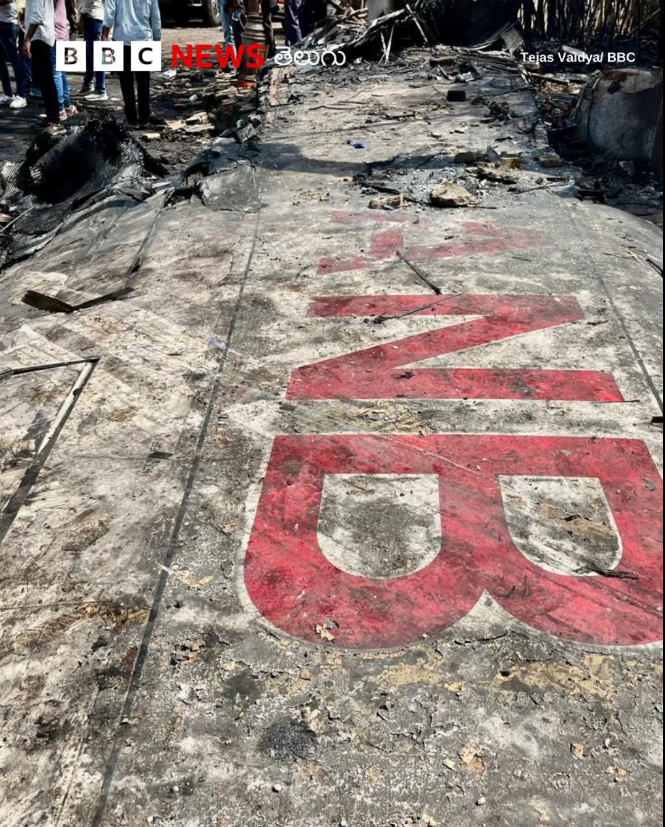
At June 12, 2025 an Air India Boeing 787, registration VT-ANB on flight AI171 with 2 GEnx-1B67 engines , on a flight from Ahmedahad (India) to London (UK) crashed shortly after takeoff, killing 241 passengers and crew. One man survived. There are 38 fatalities on the ground confirmed in addition to many injuries on the ground.
A panel headed by the Union Home Secretary is scheduled to hold its first meeting on Monday. The committee is expected to submit its report within three months, Civil Aviation Minister K Ram Mohan Naidu said. The panel will focus on determining the cause of the crash and drafting standard operating procedures to prevent such tragedies in the future. (source)
What could have caused this aircraft to crash? This is the first hull loss of a Boeing 787.
Summary
The takeoff roll was normal. At or a few seconds after the rotation one or both engines failed for unknown reason. The RAT deployed. Aircraft stopped climbing and glided and then crashed.
Nothing new to report. I take AVherald.com news with a bit of grain. Media in India did not report anything new on this crash.
Lots of discussion on forums like Pprune.org and AVherald.com. A shame a lot of nonsense is posted there and a lot of questions asked again and again. Indian media report whatever they want, sometimes even nonsense of stuff invented by journalists.
At June 19 the media reports the blackbox is send to the US because the blackbox is to much damaged to be read out in the lab in India (source)
At June 24 authorities said that the black boxes are still in India.
Two videos appeared on the internet which together with Flightradar24 data helps to analyses what could have caused this terrible crash. Mind this article is speculation. We have to wait for the preliminary report to understand all the facts.
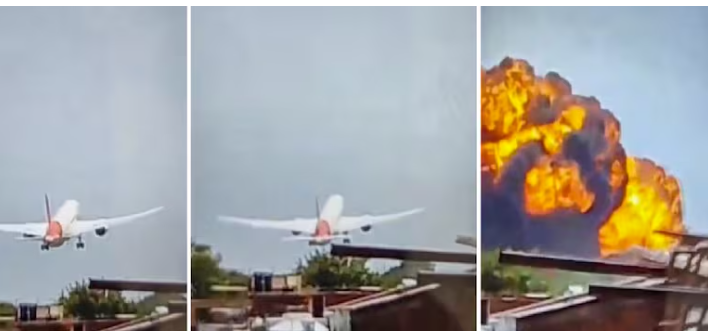
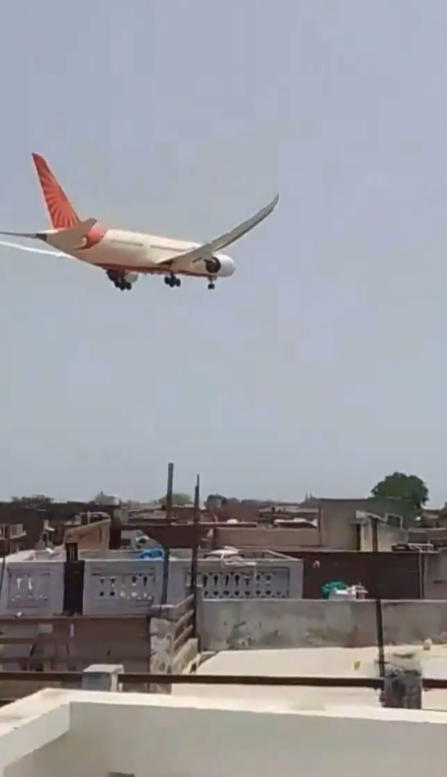
One of the two videos posted in internet shows the aircraft seconds after becoming airborne. It was filmed from an apartment building close to the end of the runway. The Boeing 787 is descending with its gear down. The video lacks the resolution to judge if the flaps were deployed.
The boy who made the video was interviewed by Indian media. There is no english translation yet. Seventeen year old Aryan Ansari who recorded the video of the Air India Dreamliner 787-8 crashing to the ground and getting engulfed in massive flames said he was attempting to capture how planes fly to show his friends when the mishap took place.
The aircraft clearly lacks lift. That can be caused by either the engines not delivering the required thrust or a faulty configuration of the wings like incorrect flaps setting.
The other video filmed by a CCTV camera, which has no sound, near the runway shows the aircraft on its takeoff roll until it crashes in the populated area. The takeoff appears normal until around 12 seconds after the aircraft started to rotate. After 12 seconds the aircraft did not climb anymore and slowly started to descend.
On Jun 15th 2025 Government Officials reported the aircraft had a longer than normal takeoff run and used almost all of the 3505 meters/11499 feet long runway. (source Avherald) .
Note: this is contrary to the FR24 data. The ‘ longer than normal’ was reported by the Times of India. The article begins with the wrong mayday call which was invented by a journalist.
Likely the official said the aircraft used the full runway, hence it did not use the intersection for takeoff but taxied to the beginning of the runway, backtracked and started the takeoff roll.
The only survivor told what happened. There was a lot of confusion about his statement earlier.
“After take off it felt as if we were still in one place & not moving. Then the sound of the engines racing (common Indian term for revving of engines on bikes & cars with the clutch depressed) & then green & white lights came on (so no flickering) in the cabin as we hit something.”
Based on the tilted position of the main landing gear a pilot error by instead of the gear retracting the flaps can extremely liked be ruled out. See for the explanation below.
As always the media asks many people and experts for comment. Speaking to Sky News Australia, former commercial pilot Captain Byron Bailey said it was pilot error. He started telling the only survivor was seated in the back of the plane. Which is incorrect as this man was seated in seat 11A in the front.
There is quite a lot of discussion about the RAT deployed or not. Mind there are several different copies of the same video published on many website. Many edited the video so the sound which many think is the RAT cannot be heard on that video. This video has in the first two seconds what sounds like a propellor.
Indications of an engine failure
There are three indications of an engine failure. Mind in many cases of plane crashes in the first days events are reported by media which turn out to be not true. So we need to be carefull.
Firstly the Directorate General of Civil Aviation (DGCA) which is India’s civil aviation safety regulator, said the aircraft took off at 13:38 IST and issued a “MAYDAY” call at around 13:39 IST approximately a minute after take-off. Some media report that the call was ” “Mayday … no thrust, losing power, unable to lift!” (source). However a source at ATC stated the pilot only said ‘ mayday” (source)
At June 13 the DGCA orders Air India to inspect engines and other components of the Boeing 787.
See below for more indications.
Indications of a wrong flap setting
On both videos it is not possible because of distance and low resolution to judge if the flaps were deployed or not.
It is very likely the slat on the front of the wings were deployed. The video clearly shows a black line at the front of the right wing. These are the slats.
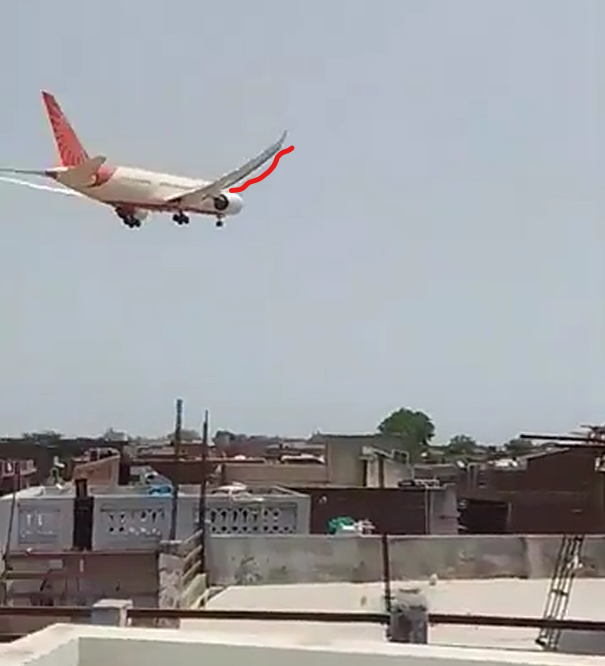
In this screenshot the slats of the rightwings can be seen in the deployed state.

This screenshot of a video seems to indicate the flaps were deployed as well. However movements could have been caused by forces as a result of the crash.
So these are some of the scenarios which could have caused the lack of lift and the crash:
Both engines stopped providing trust as a result of a bird strike.
This scenario is now almost ruled out as no remains of bird were found on the runway.
The airport is known for birds strikes. However there is no evidence on both videos of a bird strike. Normally flames can be seen or smoke coming from the engine. There is nothing on video.
On Jun 13th 2025 the DGCA reported, that initial preliminary findings rule out a bird strike as no bird carcasses have been found. (source)
Gujarat state, where Ahmedabad is located, reported 462 bird strike incidents over five years, with most occurring at Ahmedabad airport, according to Civil Aviation Ministry data tabled in Parliament in December 2023 (source).
The Ram Air Turbine (RAT )
So what happens when both engines fail is that there is no electricity for the cockpit instruments. What will happen is that the Ram Air Turbine (RAT )will be deployed. The Ram Air Turbine is an emergency device that automatically deploys in the event of a complete loss of electrical power and/or hydraulic pressure from the engines or APU. It is a small turbine (propeller) that is driven by the airflow during flight.
When the RAT is deployed it sounds like a turboprop aircraft. And that sound is exactly what you hear in the first few seconds of the video. There is no sound of two big engines with full power seconds after takeoff. Mind there are two versions of this video on internet. One is clearly filmed from a computer screen.
The image below shows a small vertical line between the main landing gear. This is where the RAT is located. What is visible is certainly not the nose gear. However this could also be an artifact of the video.

In this video you will hear the sound of the RAT on two B787 aircraft which were flying a testflight. Compare it to the video of the crash.
Besides the mayday call, the possible deployment of the RAT indicated by the noise and the image there is another indication of an electrical failure because the engines failed.
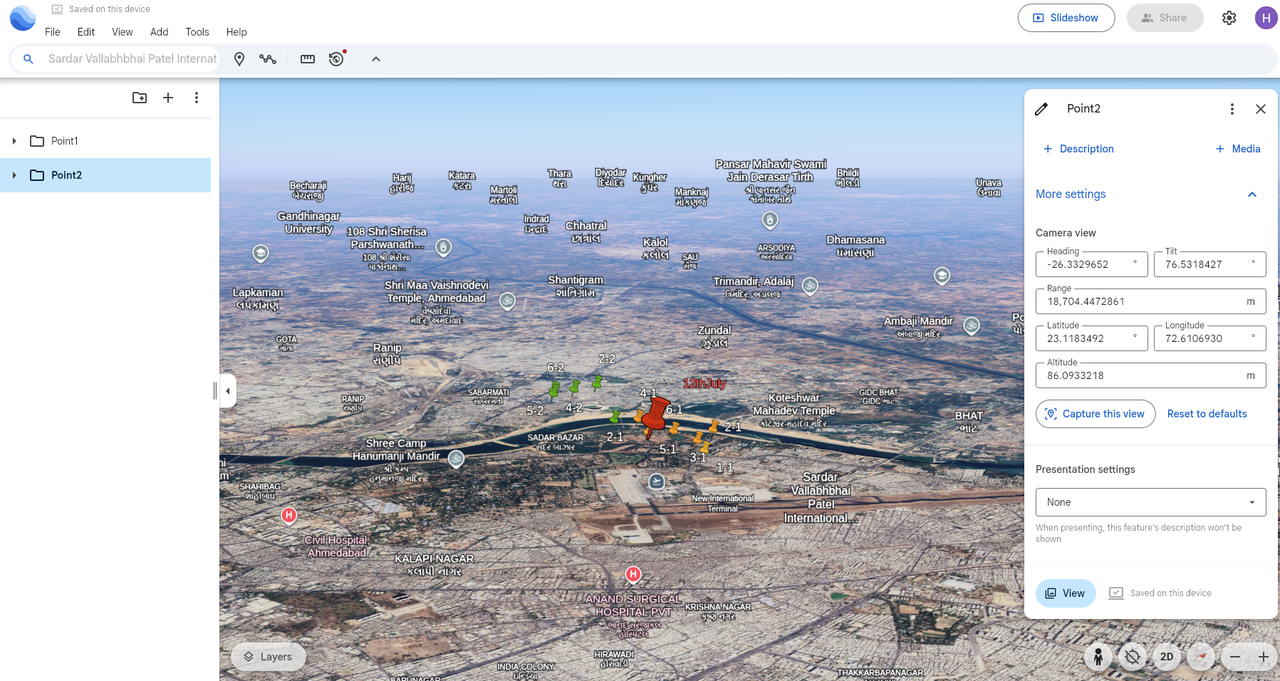
FR24 data appears to stop shortly after airborne but well before impact. The data shows 8 plots after liftoff. Thereafter FR24 did not receive any data from the aircraft. (source) The image below was made by DaveReidUK.
FR24 releases the raw data of the flight here.

Someone on Pprune analysed the FR24 data of previous Air India B787 who took off from this airport with destination London. He took the data of the past 7 days of this flight and downloaded the raw .CSV data for each flight. From that he took the first sample with an altitude of above 0 i.e. the first point that the flight looked to be airborne. On his picture these are labelled as 1-1, 2-1, 3-1 etc and orange. The crashed flight path is in red with a larger marker. As you can see, it appears to be in the same position in space as every other flight this week at the same point in time. What this showed that all of the other flights in the last week did manage to transmit a data point before they flew over the crash site so had the crashed flight transmitted anything there is a reasonable chance that it would have been picked up in a similar location to the others.
In other words, the lack of data of the crashed Air India flight near the crash site, while other flights did transmit data, indicates FR24 has coverage but the crashed flight did soon after takeoff not transmit any more ADSB data. Another indication the electricity was lost.
Possibility: maintenance error
An error made during maintenance could be the cause. Very unlikely but nothing can be ruled out.
Possibility: Both engines stopped caused by fuel contamination.
Both engines shortly after takeoff at the same moment stopped as a result of fuel contamination. This is very unlikely. Fuel contamination is extremely rare. The pilots would probably have noticed the engines not running smoothly during the takeoff roll. Also it seems both engines stopped at the same as the wings remain level. If one engines fails before the other you would expect the wings to move a bit. No other crew reported that day issues with fuel.
Possibility: Both engine fuel cut off switches where set by one of the pilots resulting in both engines not receiving any fuel and lost of trust.
Extremely unlikely the crew would make this error. Or one of the pilots did it deliberately.
Possibility: An uncommanded shutdown of both engines. A software error or other event causing the engines to stop providing thrust
Extremely unlikely. However a dual-engine failure on ANA Flight NH 985 occurred after landing at Osaka Itami on January 17, 2019.
Shortly after touchdown, the pilots engaged thrust reversers—but the aircraft hadn’t completed its transition into “ground mode.” The Boeing 787’s protective system, TCMA (Thrust Control Malfunction Accommodation), interpreted this as potentially dangerous “uncommanded high thrust.” As a result, TCMA automatically shut down both Rolls‑Royce Trent 1000 engines to prevent a possible incident. Post-landing inspections found no mechanical or fuel issues, reinforcing the conclusion that this was a software/protection system response, not a hardware failure. This B787 had Trent 1000 engines.
One possibility is a malfunction of the FADEC.
Full Authority Digital Engine Control (FADEC) is an integrated system of electronic hardware and software that manages all aspects of aircraft engine operation. Unlike older mechanical or hydro-mechanical systems, FADEC is fully digital and exercises complete control over engine functions without manual pilot intervention for most engine operations.
This video explains the role of the FADEC in an Airbus A320.
The primary generator for electricity are the engine-driven generators.
The FADEC is powered by its own power generators connected to the engines. As long as the engines are running, the FADEC has power. Each engine-mounted FADEC unit has a dedicated Permanent Magnet Generator or PMG. The PMG is mechanically driven by the engine itself, so as long as the engine is rotating, the PMG supplies power to the FADEC independently of the aircraft’s electrical system.
-Only for engine start the FADECs are powered by the aircraft. Once the engines are running, this connection is opened. It is verified, that the FADECs are then no longer connected to the aircraft electrical system. A failure to open the connection triggers a “No dispatch” message
In case the PMG fails, the FADECs are once again powered by the aircraft electrical system.
On the Boeing 787, the engines—General Electric GEnx or Rolls-Royce Trent 1000—are equipped with dual-channel FADEC units. Each engine has two independent digital channels for redundancy, ensuring continuous operation even if one channel fails.
The FADEC units used in many GE engines are made by a company called FADEC International. This is itself a joint venture between BAE Systems Controls and Safran Electronics & Defense.
When a B787 is installed with the Rolls-Royce Trent 1000 engine the FADEC installed is produced by RR itself. So here no FADEC International made FADEC.
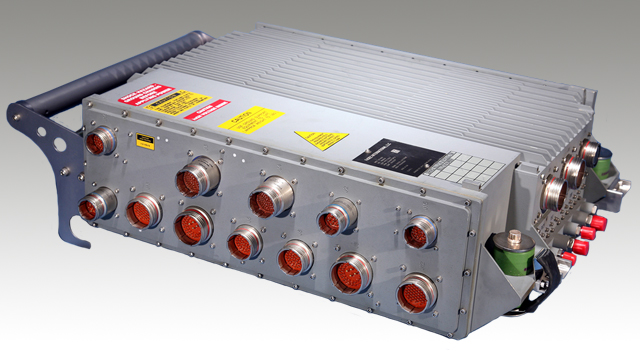
FADEC is responsible for:
- Thrust Management
FADEC calculates and delivers the precise amount of thrust based on pilot commands and environmental inputs. It adjusts fuel flow, variable stator vanes, bleed valves, and other parameters to optimize power output.
2. Engine Start and Shutdown
Starting the engine is largely automated. FADEC manages the ignition sequence, fuel scheduling, and spool-up timing. It also ensures safe and sequenced shutdowns.
3. Performance Optimization
It constantly monitors engine parameters—pressure, temperature, rotational speeds—and adjusts operation for maximum efficiency and reduced emissions.
4.Health Monitoring
FADEC continuously collects data on engine performance and condition. This data is used for on-ground diagnostics, predictive maintenance, and integration with Boeing’s Airplane Health Management (AHM) system.
5. Protective Logic
FADEC includes protection algorithms against overtemperature, overspeed, or surge conditions. It prevents unsafe operations by limiting pilot commands when they exceed safe engine parameters.
6. Communication with Other Aircraft Systems
The FADEC interfaces with the aircraft’s avionics network, flight management system (FMS), autothrottle, and the Electronic Engine Control (EEC) within each engine.
There are a couple of incidents and one fatal crash which were caused by software errors in the FADEC system:
- Airbus A220 – Dual-engine shutdown on landing (July 11, 2021)
- Boeing 787‑8 (All Nippon Airways JA825A) – Dual-engine shutdown on landing (Jan 19, 2019). Has Rolls-Royce Trent 1000 engines
- Airbus A340‑300 / Boeing 777 (CFM56‑5C & Trent 800 engines) – FADEC PMA power-loss
- 2015 Seville Airbus A400M crash shutdown risk
Possibility:An event which caused computers to fail, wiring to fail which caused both engines to fail
Could be. Wait for investigation.
Now lets see if wrong wing configuration is a possible cause.
Wrong wing configuration
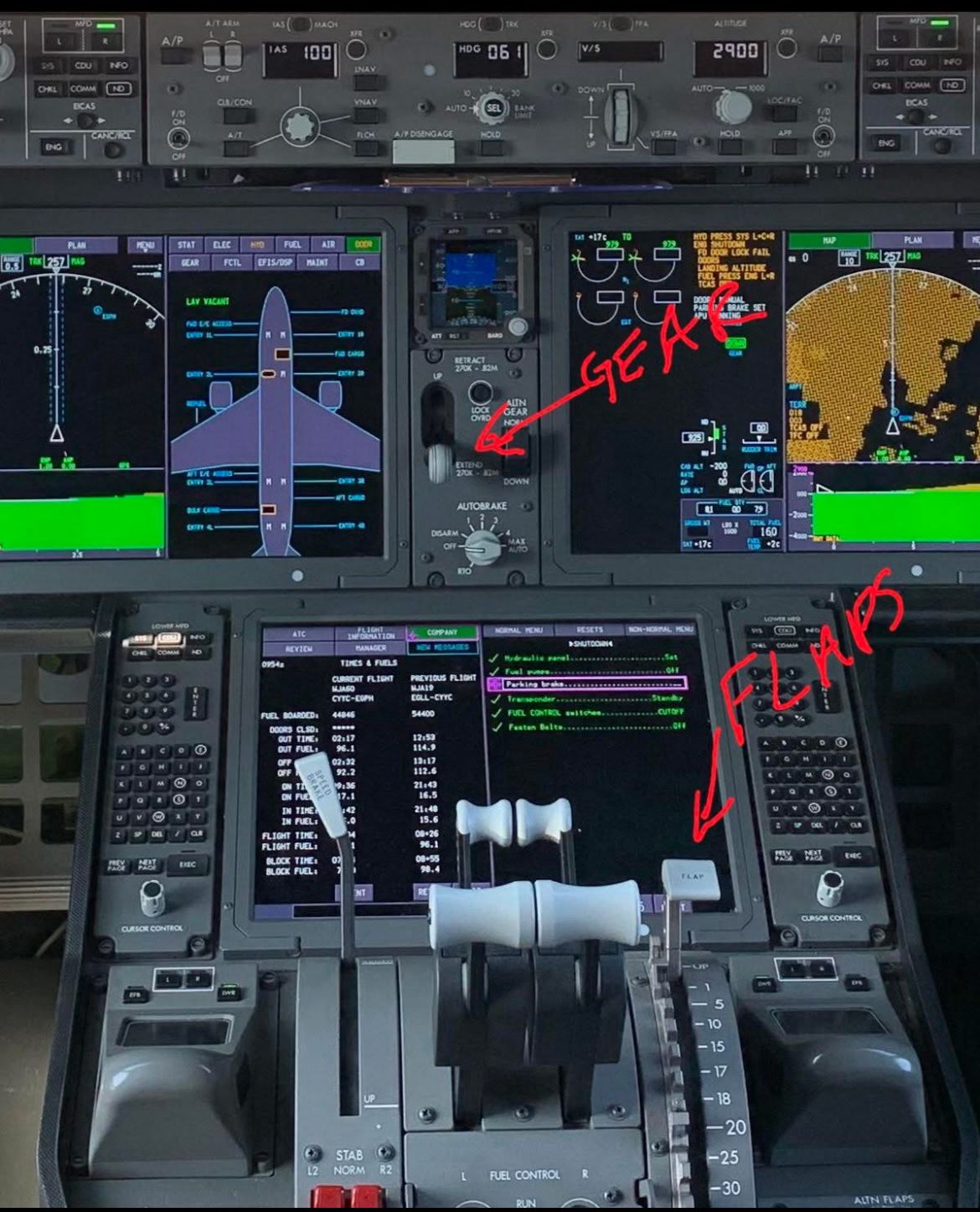
- If the aircraft was configured without the correct flaps setting immediately at applying full trust at the runway all kind of warnings would go off. Both visable and audible. It is impossible the crew would have ignored that.
- Seconds after liftoff and having positive rate of climb to pilot flying will instruct the pilot monitoring to raise the landing gear. The video clearly shows the gear was not raised. Several causes are possible. The pilot monitoring could have made a mistake and retracted the flaps instead of landing gear. Again very unlikely as the handles for both are quite far located from each other in the cockpit. However there are examples of pilots using the wrong handle. Could be as a result of fatigue.
Other possibilities
Some other possibilities are incorrect calculations of the takeoff performance. Like wrong speed to rotate the aircraft. Could be because for example more cargo was on board than in the flightplan was entered. This could result in a longer runway length required, or a tail strike. There is no indications for that.
On Jun 13th 2025 the DGCA reported, that initial preliminary findings rule out a bird strike as no bird carcasses have been found. Loading of the aircraft was routine, hence a load problem is unlikely. The likelihood of a pilot error is considered minimal as is the simultaneous failure of both engines.(source)
Another cause could be shift of cargo in the belly just after takeoff. Not likely.
What can be ruled out
Contrary to what some believe the aircraft did not rotate very close to the end of runway. People believe that because of the dust seen just after the aircraft rotates. When a line is drawn from the estimated position of the CCTV camera toward the righthand side of the small square building with the red and white squares, where the B787 starts to lift, there is a distance of runway used of around 2,31 km. This leaves 1,14 km to the end of the runway, excluding the overrun area. The dust is explained by the vortex of the wings which causes dust on the side of the runway to go up.
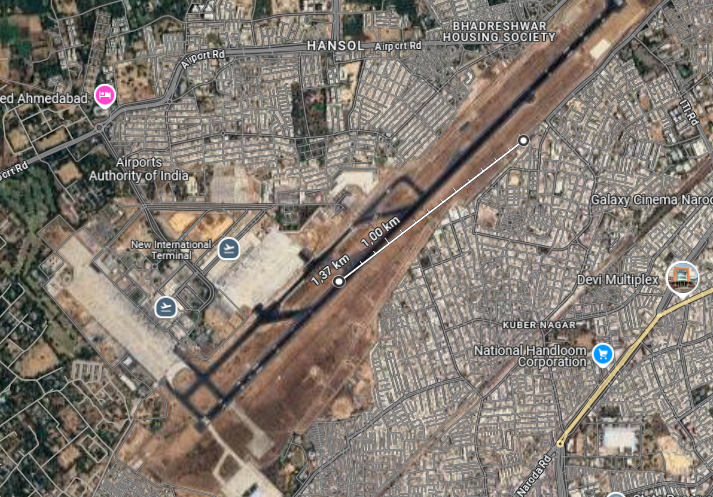
If the aircraft used the full runway the aircraft would be rotating on the video on the left side of the small building. This is clearly not the case. Also this video shows dust while the aircraft is certainly not even close to the end of the runway. The wings are longer than the width of the runway. The width of the runway is 45 meters. The wingspan of a B787 is 60 meters.
Available ADS-B data while limited does have the aircraft crossing the piano keys at a height of a good hundred or so feet, for what it’s worth. (625ft reported altitude, QNH 1001, 37°C, field elevation 189ft)
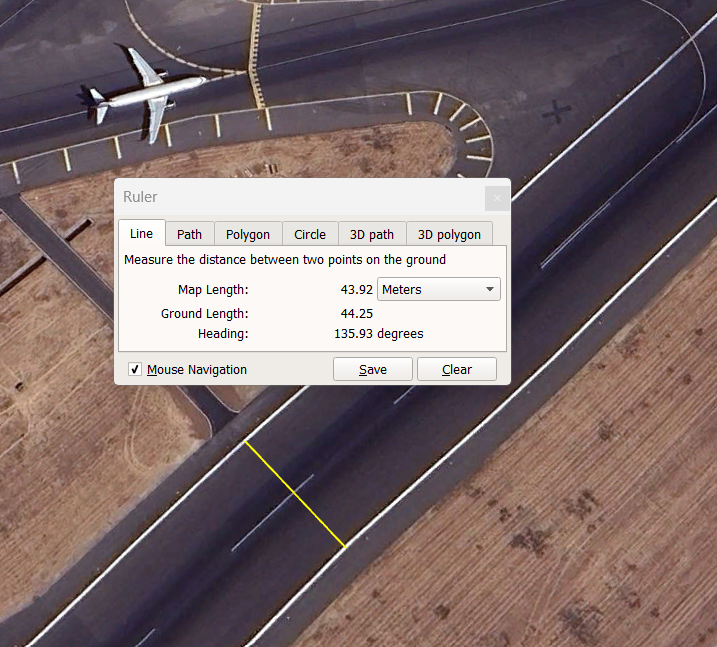
When the flight is looked at using Flightradar24 (FR24) it seems that the aircraft did not use the full length of the runway. This data is not correct. The aircraft extremely likely used the full runway. An indication is the video made by the CCTV camera. It shows the aircraft is rolling while another aircraft is waiting at the intersection. There is a turn pad between that intersection and the beginning of the runway but it is unlikely that one was used. On Pprune.org someone writes the Air India Standard Operating Procedure (SOP) prohibits the use of intersection takeoffs.
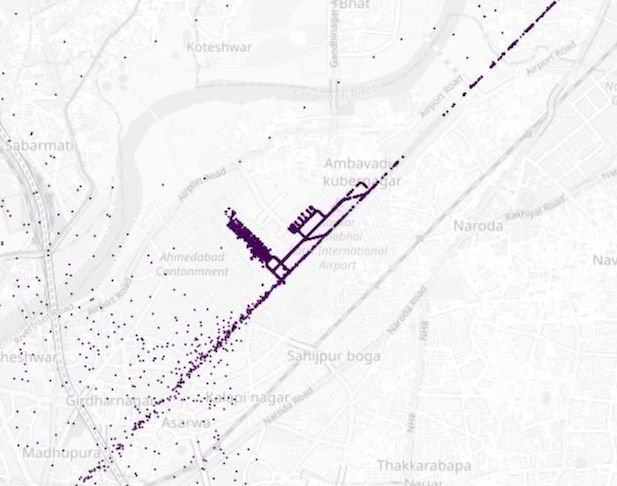
FR24 coverage (and any other ADS-B system) is poor at VAAH. Below is a 24h coverage plot made by a Pprune user. You’ll note that the backtrack section of the runway has practically nil coverage, so they may well have backtracked but it didn’t show up on ADS-B.
Wrong engine shutdown
A scenario could be one of the engines failed just seconds after liftoff. One of the pilots switched off the only other remaining working engine as a mistake. Extremely unlikely. The B788 can perform its takeoff with a single engine. The procedure for when an engine fails takes several steps. At this phase of the flight there is not need to immediately switch of a failed engine.
Pilot error by retracting the flap instead of the landing gear.
This can with great certainty be ruled out. Firstly because this error hardly happens. But more important the position of the main landing gear as seen in the video indicates the sequence to raise the landing gear had started.
On a B787-8 serie the bogie of the main landing gear tilts forwards second after lift off. You can see this in various videos. After the tilt both doors of the landing gear bay opens. Then the gear is retracted sideways into the bay. Closely watch the sequence in this video.
Now look at the screenshot. You will see the bogie is tilted forwards. So the pilot monitoring did use the handle to raise the landing gear. Very likely because of the failure of both engines and the lost of electricity the sequence of retracting the gear halted.
Pilot seat moved during the takeoff
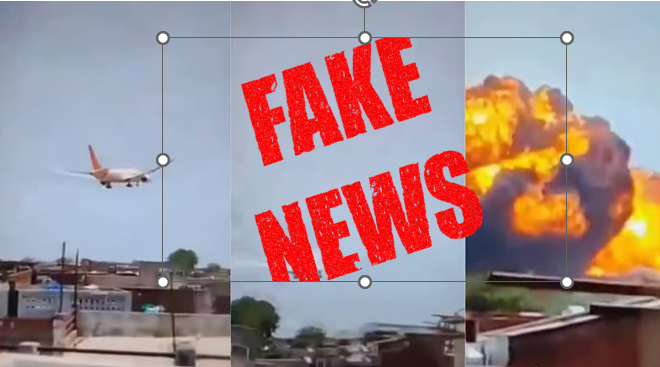
A truely nonsense story appeared in comments of multiple websites where users post the opinions and observations. The story was even published by a couple of large Greek newspapers. The story could easily be debunked as for example the date was wrong. Also the route was shown as “Route: Ahmedabad (VAAH) → London Heathrow (EGLL)” .
In short the story stated the seat of the pilot flying all of a sudden moved to the back during the takeoff. the PF hold his hand on the throttle and as a result the engine power was set to idle.
Many Greek media however reported this nonsense. What a shame.
Nonsense. The 787 seat can move backwards if you press a button and activate an electric motor or manually, by lifting a lever that allows the seat to slide freely on the rails.
If you don’t touch this lever or if you do not press the switch, the seat won’t move at all, it’s blocked. During takeoff the seat can’t move backwards suddenly without pulling that lever. Inadvertent seat movement it’s impossible.

“A software error or other event causing the engines to stop providing thrust
Extremely unlikely. There are no reports this ever happened to a Boeing 787.”
This is not quite right – there was an ANA flight on Jan 17th 2019 that had exactly this due to a TCMA error after landing. Additionally the EEC module on GEnx-1 engines requires periodic replacement under an AD.
TCMA is there to prevent engine runaway and should only operate on the ground. However is is notable that AI171 appears to have lost thrust immediately after transitioning from ground to air.
It would have been nice to have my graphic credited.
DaveReidUK
Credit just added.
ESPIRIDI Podcast
‘Spoofing the Dreamliner B787: Cyber Risks in Modern Avionics.’
Very interesting.