Faulty fuel cutoff switches on the Boeing 737 explained
The preliminary report on the crash of Air India 171 mentioned both cutoff switches moved from RUN to CUTOFF seconds after liftoff. In this article we will explain why a faulty switch can be moved to the CUTOFF position without a person in the cockpit doing so. This faulty switch has only be installed on some Boeing 737 aircraft. There are no reports a faulty switch was installed on a Boeing 787.
Any discussion on faulty fuel cutoff switches on a Boeing 787 is a red herring.
There were no “flaws” in the switches themselves. The original SAIB came about because some switches on 737s were found to be installed incorrectly.
This a good video explaining the working of the switches. You will learn that the switches of the crashed Boeing 787 were replaced when the Thrust Control Module was replaced.
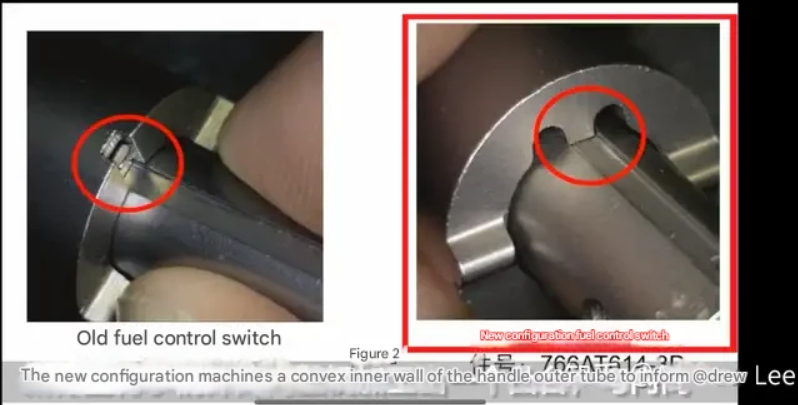
These same switches are used on about 7,000 aircraft. A new part (766AT614-3D) with a new locking mechanism that could not be installed incorrectly was made for the 737.
The 787 uses an entirely different part number (4TL837‑3D). 1,200 787s with 30 million flight hours and 5 million departures. Not one instance of one, let alone two switches not working as designed.
At July 16 Reuters reports Air India has completed the inspection of fuel control switches on Boeing 787 planes with no issues being found, Indian broadcaster NDTV said on Wednesday, citing an official.
Even if a faulty switch was installed on the Air India aircraft, the chances of both switches automatically moving to the CUTOFF position without a pilot doing so within 1 second of eachother is extremely low. There has not been any report on a Boeing 787 where the fuel cutoff switch moved by itself without the need to lift the toggle. Also the FAA nor Boeing issued any safety notice about faulty switches since the bulletin issued in 2018.
The aircraft achieved the maximum recorded airspeed of 180 Knots IAS at about 08:08:42 UTC and immediately thereafter, the Engine 1 and Engine 2 fuel cutoff switches transitioned from RUN to CUTOFF position one after another with a time gap of 01 sec. The Engine N1 and N2 began to decrease from their take-off values as the fuel supply to the engines was cut off.
“In the cockpit voice recording, one of the pilots is heard asking the other why did he cutoff. The other pilot responded that he did not do so.” Both fuel control switches were found in the wreckage in the RUN position.
How the position of the switch is changed is demonstrated in this video.
So the forces of the crash prevented the switches from moving to the CUTOFF position.
These new electrical switches have a red cross light in them that will illuminate in case an engine fire condition is sensed. This indication, together with the illuminated engine fire handle, will help identify which engine is on fire.
This is extra important in the case of an engine fire as an engine on fire might still be producing thrust, and therefore will not give the pilots the characteristic asymmetric power situation that an engine failure will.
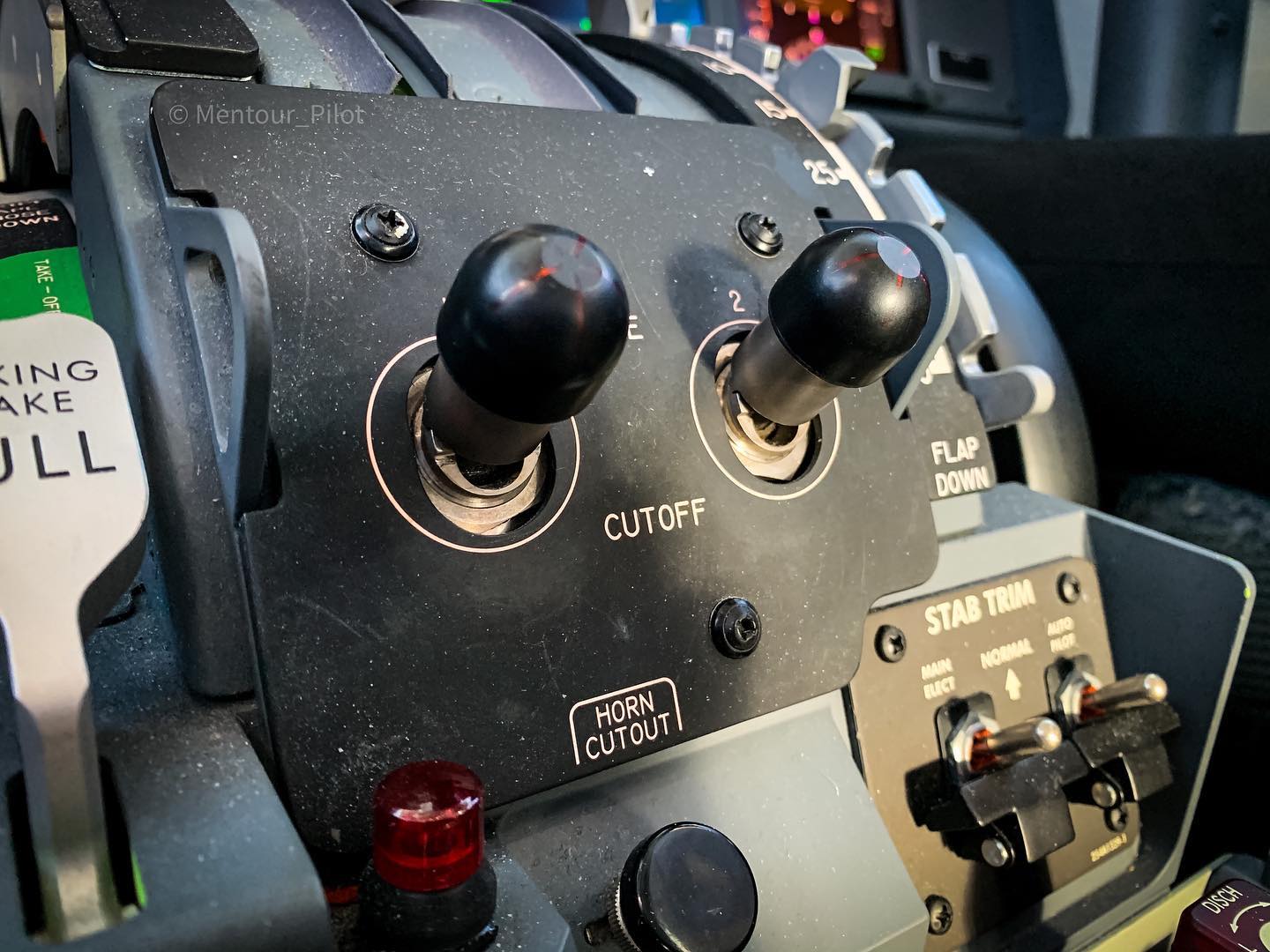
While these Honeywell made switches on have a safety lock preventing the switch to move by forces like something hitting the switches, there is a FAA Special Airworthiness Information Bulletin (SAIB) stating the danger of the potential for disengagement of the fuel
control switch locking feature. The FAA advises operators of the Boeing 737 to replace the fuel cutoff switch.
For all other Boeing aircraft like the Boeing 787 the advise was to inspect the locking feature of the fuel control switch to ensure its engagement. The purpose of the inspection was to get an overview if on other models than the Boeing 737 also an issue is on the switches. There was not.
The India Aircraft Accident Investigation Bureau (AAIB) writes in its preliminary report:
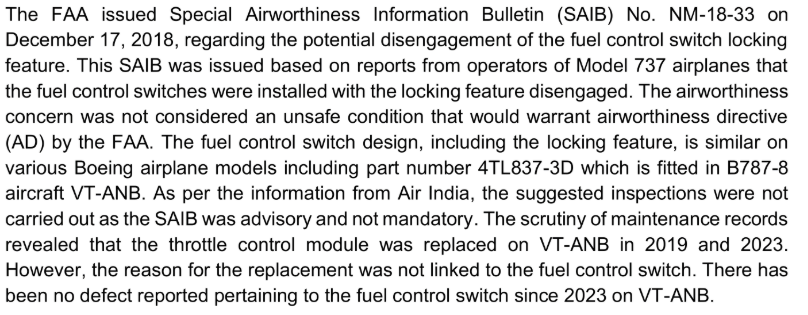
The FAA wrote in SAIB No. NM-18-33:
In order to move the switch from one position to the other under the condition
where the locking feature is engaged, it is necessary for the pilot to lift the switch up while transitioning the switch position. If the locking feature is disengaged, the switch can be moved between the two positions without lifting the switch during transition, and the switch would be exposed to the potential of inadvertent operation. Inadvertent operation of the switch could result in an unintended consequence, such as an in-flight engine shutdown.
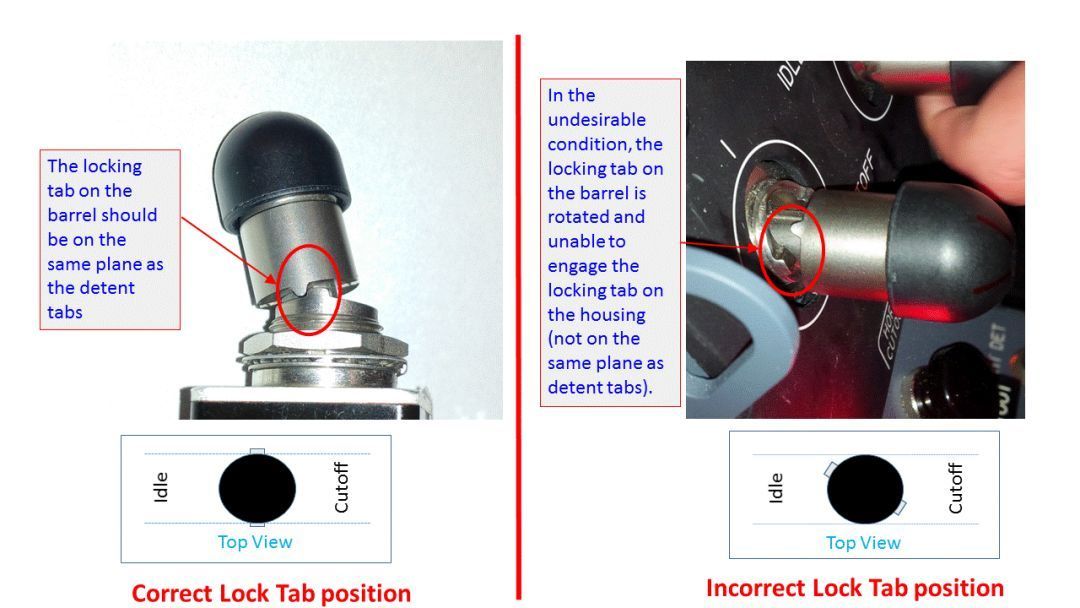
So what does it mean when the locking feature is disengaged? Two pictures which were found on a Chinese website explains. Mind these show a switch installed on a Boeing 737 aircraft (the photo shows part of the word IDLE where the B787 has ‘ RUN’ ).
When the locking feature is working, the switch (toggle) with the black knob and red leds) can only be moved from RUN to CUTOFF position by lifting the toggle using the thumb and a finger. There is a spring in the toggle which makes it impossible that the toggle moves by forces other than the hand of a human. This guides the toggle over the detent tabs on both sides of the base of the switch.
The toggle of a faulty switch can rotate. In that situation the locking feature is disengaged as the locking tabs of the barrel now do not need to pass the locking tabs.
This was solved by Honeywell by some adjustments on barrel. (text continues below the image)
This Airbus pilot tells a story about a fuel cutoff switch which could be moved without lifting the toggle. (around 15 minutes in the video)