

Suicide or error by one of Air India 171 pilots is the elephant in the room in India
I studied a lot of comments by people from India about the possible cause of the crash of Air India 171. All facts point to suicide by one of the pilots. There is no evidence for a faulty switch, let alone both switches failing at the same time at such an important phase of the flight. However some pilots from India refuse to believe one of the pilots deliberately set both switches to the cutoff position.
A deliberate act by one of the pilots is by far the most likely cause of this crash.
However people working in the aviation industry from India seem to avoid this cause.
One of the first examples is a few sentences on the well respected website AVherald.com. This website publishes about incidents and accidents on civil aviation. However the statement below is wrong:
On Jun 17th 2025 an official, a former Air India Captain trained by the Captain of the accident flight, stated, that the CVR has been successfully read out, the voices on the CVR are very clear. It is becoming gradually clear from the newly emerging evidence that there was probably zero negligence in the cockpit, the crew did not give up until the very last moment. The probability of a technical cause is high. A preliminary report by India’s AAIB can be expected in a few days.
This has now been deleted from the website but there is still an archive.
It shows reports, especially in Indian media, should be copied extremely carefully.
There are many more examples of nonsense being said by experts. There is a lot of nonsense on a safety notice on fuel valve actuator. Media made a link to the fuel control switches.
For example Sharath Panicker. He flew the B787 for 10 years as a captain. On a video published at July 14 by Mint (an English-language business and financial daily in India), so after the release of the preliminary report, he says it is ‘ extremely unlikely‘ the pilots had moved the fuel cutoff switches. He has the opinion that both switches cannot be moved to CUTOFF position within one second of each other. He explains a pilot needs to find the switch location, take the switch, move it up and move it to cutoff. And repeat the process for the second switch.
However his story does not make sense. It is perfectly well possible to change both switches in 1 second. Mind the frequency of registration of the position of the switches on the Flight Data Recorder is 1 second. So it could be 1,99 second difference as well.
These two videos show the two switches can be moved from RUN to CUTOFF in just one second (video 1 and video 2 )
A few days later Panicker stated on Mojo that ” the black boxes have read electronic signals while switches not physically moved”. That is really an incredible statement. First of all because the cockpit voice recorder extremely likely recorded the sound of the switches being moved to CUTOFF. Secondly likely the pilot flying noticed the switches were moved because he asked the captain why he did the cutoff. Thirdly the black boxes recorded the switches were set to run again. And the black boxes recorded that after that the engines started to spool up again. Forth there is no known case where a black box registered incorrectly movements of switches.
Panicker tells nonsense.

Manmath Routray is another former Air India captain who flew on the Boeing 787. He was trained by the captain of the crashed aircraft, Sumeet Sabharwal.
In this video, published at July 15, Routray suggests that because of the power of Boeing they blame the pilots. He tells the AAIB just published a small part of the conversation in the cockpit. Routray does not explain a preliminary report is most cases has just a summary of facts. There can be multiple reasons not to publish the complete conversation yet. One of them is that this could be a criminal case. Routray says Captain Mohan Ranganathan, one of India’s leading aviation experts, is mental. Ranganathan said that Sumeet Sabharwal had mental issues after his mother died. Ranganathan has the opinon the crash is pilot error or suicide.
The report is according Routray meant to protect America and Boeing. He thinks there was an error in both engines and that is why the switches were moved to the cutoff position. He calls the preliminary report a ” complete failure of investigation. Transparency zero”.
The video makes clear some experts presented by media have a lot of national pride.
Mojo Story, with 2 million subscribers on YouTube, made several video’s in which the crash is discussed. The presenter and editor-in-chief, Barkha Dutt, is biased. She mentions the FAA Special Airworthiness Information Bulletin (SAIB). However this SAIB was clearly meant for the switches on the Boeing 737 and not for the B787.
In 2008-2009 Dutt was part of a scandal called Radia tapes. Critics argued she crossed ethical lines by appearing to act as a go-between rather than maintaining professional distance. In her conversations, Barkha Dutt is heard offering to “pass messages” to the Congress party leadership (particularly to Ahmed Patel) to help facilitate discussions.
Former pilot of Air India Sanjay Gupta was a guest in the discussion on Mojo Story.
Manmath Routray, we discussed him earlier in this article, was also a guest.
The third guest is Captain C S Randhawa. The former Deputy Chief Flight Operations Inspector at the Directorate General of Civil Aviation (DGCA) has 45 years of flying experience, including 37 years of flying Boeing aircraft and fighter planes. Currently he is President of the Federation of Indian Pilots.
The forth former pilot who joined the discussion at around 30:50 is Captain Rakesh Rai, who flew Boeing 787 aircraft for Air India as recently as last year.
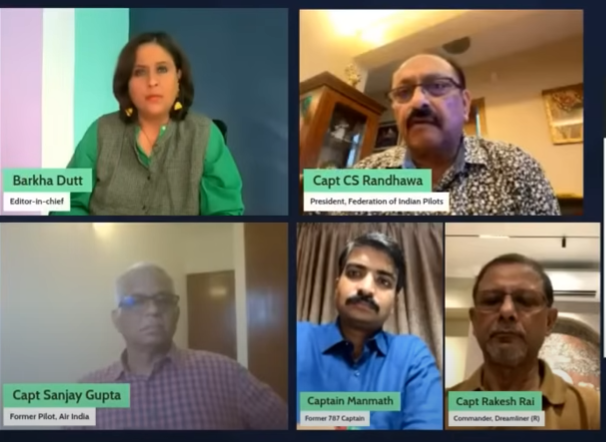
Gupta starts with saying the names of who said what in the cockpit should be part of the preliminary report as well as the exact time when one of the pilots asked why the other set the switch to cutoff. He finds its strange that the report states no actions by Boeing and General Electric (the manufacturer of the engines) is needed. “there is a lot of misleading and insufficient data” he said. Also mr Gupta did not study all the facts. He says the FAA stated the switch can malfunction. However that was only observed in some cases in the Boeing 737 where the lock mechanism could not work. He says that no pilot in the world will switch off the engines at that altitude.
Suicide is the elephant in the room. Earlier pilots committed suicide and murdered their passengers and crew. Silk Air, Egyptair, Germanwings, China Eastern and LAM are some examples.
Gupta suggests Boeing is protected by the preliminary report.
Manmath suggests there was something wrong with both the engines and that must be the reason for the pilots to set the switches in the cutoff position. It does not make sense at all. Firstly a dual engine failure just after liftoff is unique. Secondly one of the pilots asked the other why he cut the fuel. The other responded that he did not. That is not a reaction which matches a situation where the pilots reacted to a dual engine failure.
Manmath simply does not want to think about a deliberate action to cutoff the fuel. As as a result both engines failed. He suggests a ‘ double engine flameout’. However there are no indications in the CCTV video. The preliminary report does not mention anything about engine issues.
Gupta says ” the Boeing 787 has the problem with the faulty switches”. However he is not correct. This was related to B737 switches. As proven by the fact there is a new part number for an improved switch for *just* the Boeing 737.
Everyone in the discussion at Mojo is using goal-oriented reasoning. It must be true that there was a motor problem, and only then were the switches set to the cutoff position. They all ignore relevant facts. This is an example where chauvinism trumps facts
Mojo multiple times show the Boeing 737 MAX cases. Which is totally not relevant to this crash. Different aircraft, different cause of the crash, different circumstances.
All experts believe there was a problem with both engines just after rotation which caused the crash. And which caused one of the pilots to set the switches to cutoff. Again, it does not make sense at all.
Captain Rakesh Rai says ” there is a problem with the switches on the Boeing 787 and to cover up this problem they mentioned all other aero planes” .
What this conversation show is an incredible groupthink. It seems people should defend pilots and ignore the facts.
The bias of Mojo is proven by for example this photo showing a KLM B787. A windshield crack can happen on an vehicle and aero plane. It does not make any sense to show the KLM B787.

Randhawa suggest the TCMA gave a wrong signal to the engines. He ignores the fact that both fuel control switches were moved to the cutoff position.
Earlier Randhawa made another factual incorrect statement. For Opindia he was quoted below. Randhawa means that because of standard operation procedures two pilots must be involved in changing the position of switches , making accidental or solo activation unlikely. However if a pilot has the intention do set the switches to CUTOFF he can perfectly do that without consent of the other pilot.
If there as a challenge-response system in the cockpit there would be far more than three seconds between the liftoff and the setting to CUTOFF.
Notably, veteran pilot and president of the Federation of Indian Pilots Association, Captain C S Randhawa, has rejected the assertion against the pilots outright. He said, “The report is inconclusive. The fuel switch follows a challenge-response system. It cannot be done in isolation or by accident.”
Randhawa also said here (around 08:30) that he was sure the pilots did not touch the fuel control switches because they were found in the RUN position after the crash. This statement is really of an incredible ignorance.
Randhawa send a legal letter to both Wall Street Journal and Reuters because they reported it was the captain who set the switches to CUTOFF.
Captain Rakesh Rai says the captain was a very experienced pilot who trained other pilots. No way his hand could have gone by accident to the switches and set them to the cutoff position.
The goal-oriented reasoning is once again proven when the journalist said the pilots did restart both engines. First of all we do not know who set the switches back to RUN. Also if this was a calculated action to commit suicide the pilot knew the aircraft could never recover as spooling up the engines would take so much time the aircraft would crash before that.
Besides a deliberate act another elephant in the room is that fact that the FAA or Boeing did not publish any safety notice to operators of the Boeing 787. So that means they do not believe there is a technical error. None of the five people mention this.
Then there is M Matheswaran , former Deputy Chief of Integrated Defence Staff (IDS), who stated in The Federal.com
“There is no possibility of inadvertent tampering with the fuel shut-off switches by the pilots,” says Air Marshal (Retd) M Matheswaran, one of India’s most respected aviation minds. “By design, these are critical switches and are located such that deliberate and clear action is needed to operate them. This is a mechanical and electronic system failure, not human error.”
A few days later CS Randhawa is quoted by Indian media The Newsman. The Wall Street Journal had reported that the co-pilot, who was flying the aircraft, was the one who asked the captain why he did the cutoff (of the switches). The captain denied he did so.
The Federation of Indian Pilots (FIP) strongly rejected in a scathing denouncement the Wall Street Journal’s report as “baseless” and inaccurate. The Federation of Indian Pilots President CS Randhawa maintained that the AIIB’s initial report does not directly pinpoint the pilot’s fault for the fuel cutoff.
“Nowhere in the report, it has been said that the fuel control switch was switched off because of the pilot’s error. I denounce the article. We will act against them in the FIP,” he said to ANI, and added that the media houses should avoid making unsubstantiated assumptions.
Randhawa also stated
“The report, as released, lacks comprehensive data and appears to rely selectively on paraphrased cockpit voice recordings to suggest pilot error and question the professional competence and integrity of the flight crew.
Another man called as expert is Captain Ehsan Khalid. From all the experts I saw he seems the most balanced one. Although mentioning crashes of other Boeing aircraft does not make sense. Each accident should be analysed as an unique event. He says: we need to know more before conclusions are made.
Khalid explains that he thinks the electrical signal of both switches went to CUTOFF while the switches itself remain in the RUN position. This does not make sense as one of the pilots said to the other ‘ why did you cutoff? “. An indication the switch was seen in the CUTOFF position. Also there is no single known case of switches in RUN while the electrical signal is at CUTOFF. Also the report says the engines spooled up again after the switches were set to the RUN position. This makes an electrical failure extremely unlikely.
The preliminary report does not mention if the cockpit voice recorder recorded the sound of the change of position of the switches. That would rule out any electrical failure of the switches.
Aviation consultant Captain Ehsan Khalid tells the FAA advisory in the AAIB report is misleading. The switches did not malfunction in the sense these moved by itself.
Khalid states that the pilot flying could not have seen the position of the switches. Because as pilot flying he got a lot of error messages on the instruments and was busy dealing with flying the aircraft under severe stress. I do not follow Khalid here. The co-pilot likely heard the switches being moved and saw it.
For business Today he said:
In his view, the CVR quote—“I didn’t do it”—supports this. “They were responding to failure, not causing it,” Khalid concluded. “The timeline doesn’t support intent. It shows reaction under pressure, delayed by confusion or system behavior—not by design.”
This is also nonsense. There are four internal switches inside each of the two fuel control switches, with many components on the receiving end that are monitored.
The preliminary report did not say for example “The EAFR recorded the switch in the CUTOFF position but component X did not receive the close signal.” or “Component Y received a CUTOFF signal without a correlated switch signal recorded on the EAFR.”
Instead it said “The Engine 1 and Engine 2 fuel cutoff switches transitioned from RUN to CUTOFF position one after another.”
Based on the wording, we can assume that the AAIB was confident the switches were physically in the CUTOFF position.
It’s extremely unlikely that all 4 internal switches changed state simultaneously without switch activation, and a second later the same happens in the other switch.



Excellent analysis (this and your other posts on the subject). I totally agree with everything you have written in this series. As an aside, I looked up the relevant Honeywell part numbers and was stunned by the cost of each switch. Anything from $1,500 – $1,800 US. Per switch! No wonder aircraft are so expensive!