Expert quoted by the German Bild is completely wrong with his analysis of NordStream sabotage
German newspaper Bild Zeitung in early November 2024 presented the analysis of a man who was presented as an expert. He told Bild the scenario in which divers used the sailingyacht Andromeda to place explosives as ‘ impossible’. However the expert was wrong on many relevant facts. His fundament of thinking is an incorrect believe about the weight of the explosives used at the three north locations.
Bild published the story online both as a story and as a video as well as in print. In short a diving expert named Sven Thomas says there must have been a second team besides the Andromeda team which placed explosives at the three north locations. He has extreme doubts the explosives could have been planted using the Andromeda yacht. The German prosecution service believes six persons on the Andromeda placed all four explosives.
In the video Sven Thomas explains his belief in details using multiple slides. He makes however essential errors which are the fundament for his believe. Thomas is an underwater archaeologist which means he dives to shipwrecks. For his study presented by Bild Thomas was helped by other experts. Thomas however stated he is responsible for errors in the study.
Thomas made a couple of statements. First is that it was impossible for the Andromeda to keep a steady position above the pipeline. At least three anchors with sufficient length are required. The yacht just had a single anchor.
Secondly all the diving equipment is much too heavy to be carried onboard the yacht. In total Thomas calculated the weight would be around 4.000 kilograms.
Third according to Thomas each explosion at the northern sites required explosives of a weight of at least 400 kilograms. That weight is impossible to get onboard without a crane. Also the divers could not handle this.
Fourth: Thomas studied the weather. There would be only six days suited for diving from the yacht. Thomas stated there would be a minimum of eight dives to place the four explosives. There was simply not enough time to do this.
And last, the damage pattern of the three blasts in the north indicate the usage of military mines. While the single explosion on the south indicates only 20-25 kg of explosives were used.
Lets analyze the statements made by Thomas. While in the most perfect circumstances it would be ideal to have a steady diving platform with ropes /chains going down to the bottom of the sea, in case of a sabotage this setup would not work. The boat required would be too big and would attract attention. It is perfectly possible to dive using the swimdeck which the Andromeda has. On days with hardly any waves it is easy for divers to get in and out of the water. Thomas does not say it is totally impossible either as he does not rule out the Andromeda team placed the explosive at the Southern location. The divers would use a bouy and line once they planted the explosives. The crew on the boat would then see the exact position of the divers and pick them up.
At 3:00 in the video Thomas states that an explosive was attached to the pipeline which could only be placed there from the yacht which should have been positioned all the time at the same location. This means according Thomas the Andromeda must have been able to keep a steady position for a long time. That is impossible as the yacht does not have at least three anchors with enough length.
I have no idea why Thomas believes the Andromeda must have had a fixed position and dropped explosives from the yacht down to the pipeline.
The believe of Thomas is shown in this slide presented by him in the Bild video. This slide shows that Thomas believes the Andromeda had to carry 2.000 kilograms of explosives.
The statement about 2.000 is questionable as later in the video Thomas says there was at least 1.200 to 1.500 kg of explosives needed. Which is incorrect as well.
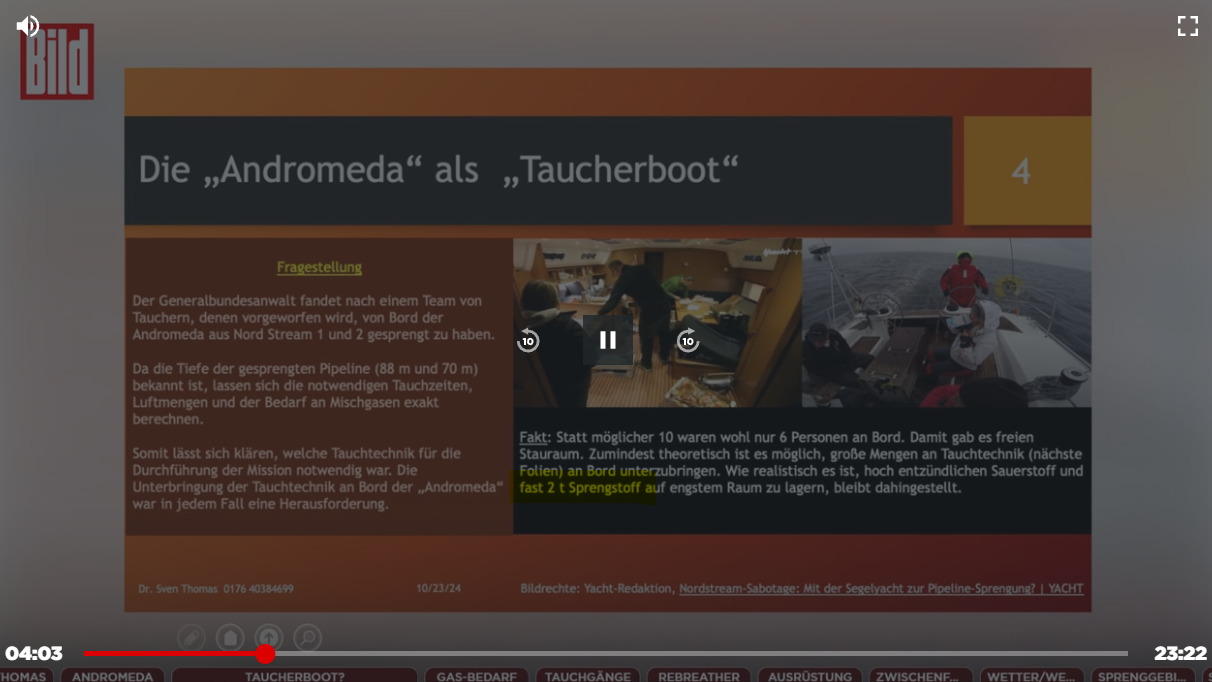
That 2.000 kilograms is incorrect. The statement is very remarkable as Thomas states he was helped in his study by experts. An explosive expert would knew the measured force of the explosives is not equal to the weight of the explosives. Firstly because the main component of the measured force can be explained by the enormous pressure inside the gas pipelines. Also the actual force caused the the explosives is less than the requited mass of TNT. The HMX explosives where likely used. For 100 kg TNT force less than 100 kg of mass explosives is required. It is explained here. Bottom line, per explosion less than 40 kg of explosions was required. So instead of the 2.000 kg stated by Thomas, a maximum of 160 kg was onboard the Andromeda.
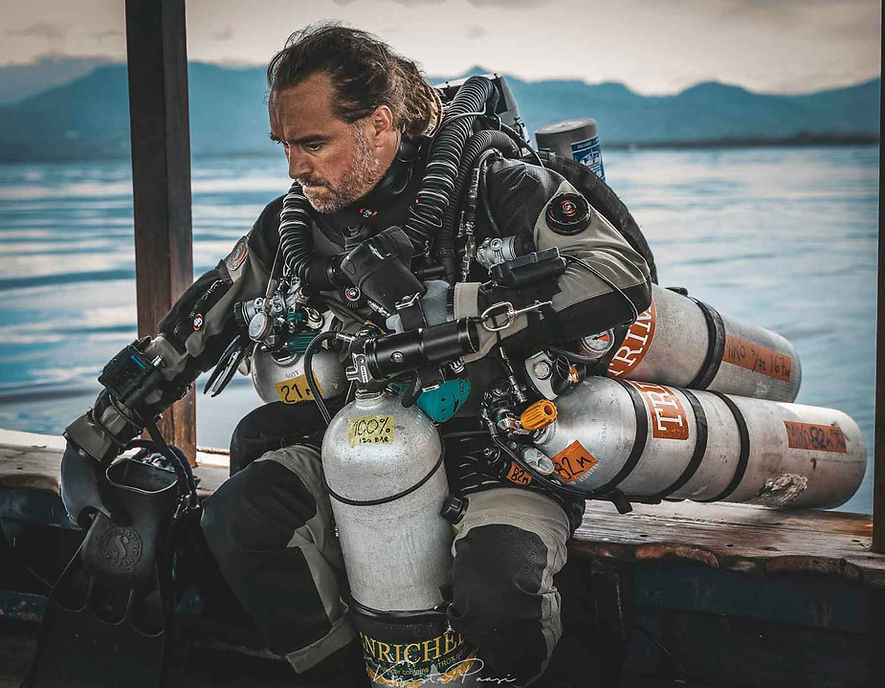
The next argument is the volume and weight of the diving equipment. To dive at a depth of 80 meters and remain at the bottom for some time to place the explosives likely a rebreather was used. A rebreather is basically a device carried by a diver on his back which recycles the exhaled breath so it can be used again as oxygen. While a rebreather requires two relative small cylinders, a backup in case the rebreather fails is required.
Thomas in the video presents two possible scenarios. The first one is the divers did not use a rebreather but a set of multiple cylinders. A total dive would take 2,5 hours. The total equipment would weigh around 110 kg at the least. So divers first need to go into the water. Then a helper must assist in fitting all the equipment.
The second scenario is a rebreather. For backup in case the rebreather fails so called bailout cylinders are required. This means the diver the divers needs to carry 4 to 5 bailout cylinders. This will make it very hard to take explosives and place them. Because of the effort to place the explosives there is a risk the diver will poison himself because the rebreather is not able to filter the CO2.
The divers looks like this (photo via https://www.mikkopaasi.com/about-3) . It is a lot of equipment but hands are free.
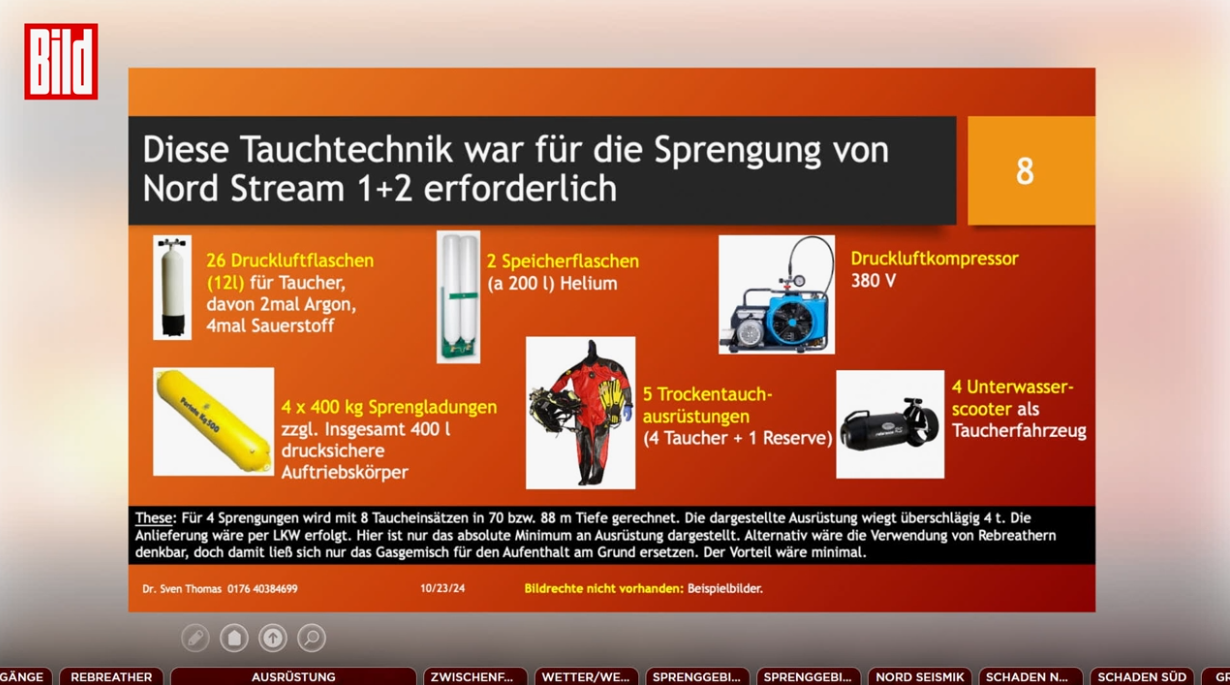
Next Thomas explains what equipment was need to bring onboard. There are 4 cylinders of each 50 liters Helium. These are 150 cm in height and weigh around 70 kg each. Thomas says in total 450 kg which I doubt. In total 200 liters of helium was needed. Thomas says it would be very difficult to carry these cylinders on board without having a crane. I do not understand why. The slide is not correct. Not 2 cylinders (Speicherflaschen) were needed, but 4 x 50 liters to have 200 liters. Thomas does not explain why these cylinders are needed. In the print edition it says 2 bottles of 200 liters each with Helium were needed. In total this would be 500 kilograms. It does not make sense at all. A 200 liter cylinder does not exist! Even if the Helium was needed it could be carried by hand by two persons on the yacht.
Also all the equipment is based on the assumption by Thomas that 8 dives were need. For each explosion site the first diver went down, searched for the pipeline, used a buoy with a rope to mark the spot and then the second diver went to the pipeline with the explosives.
While the method is not known, more likely is the crew used sonar equipment to exactly locate the pipeline. Then one or two divers went down to place the explosives. If the diver wanted to take the risk of diving alone four dives is all what was needed. In this scenario each day a dive could be made as a diver needs 24 hours of rest after a dive to 80 meters.
Again the mistake by Thomas is seen here. There was no 4 x 400 kg explosives required. The 4 x underwaterscooter does not sense as there were just two divers.
I do not see why an underwater scooter is needed. Thomas believes to carry the weight of the explosives. If the sonar on board the Andromeda could exactly pinpoint the location of the pipeline the diver could just go do vertically and would not need to move horinzontally through the water.
Again according Thomas there were 4 suits needed for four divers plus a spare one. There were two divers on board.
The slide shows the equipment needed when no rebreather were used.
Then the weather conditions. This operation could only be executed when the waves are 1 meter or less. Thomas states these conditions were at 9, 10 and 11 September, 17, 18 and 19 September and 21, 22 and 23 September.
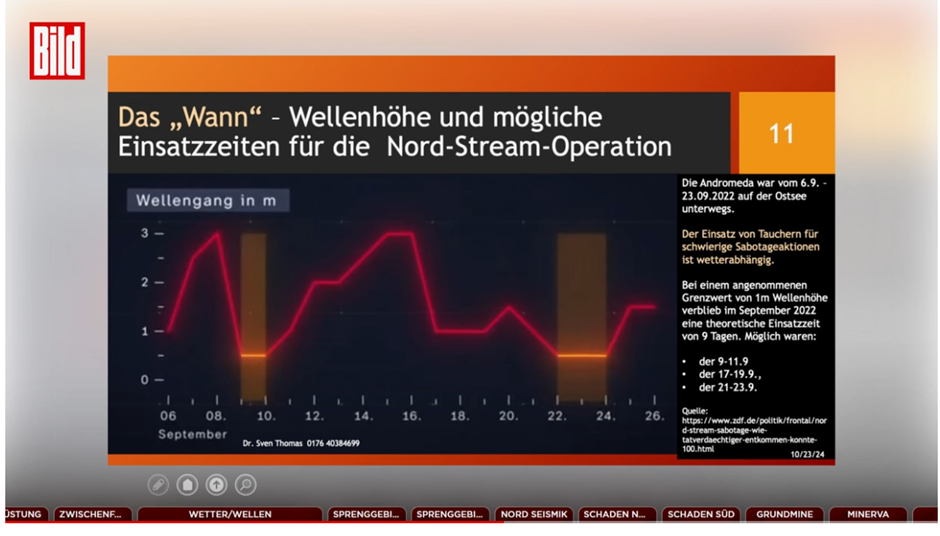
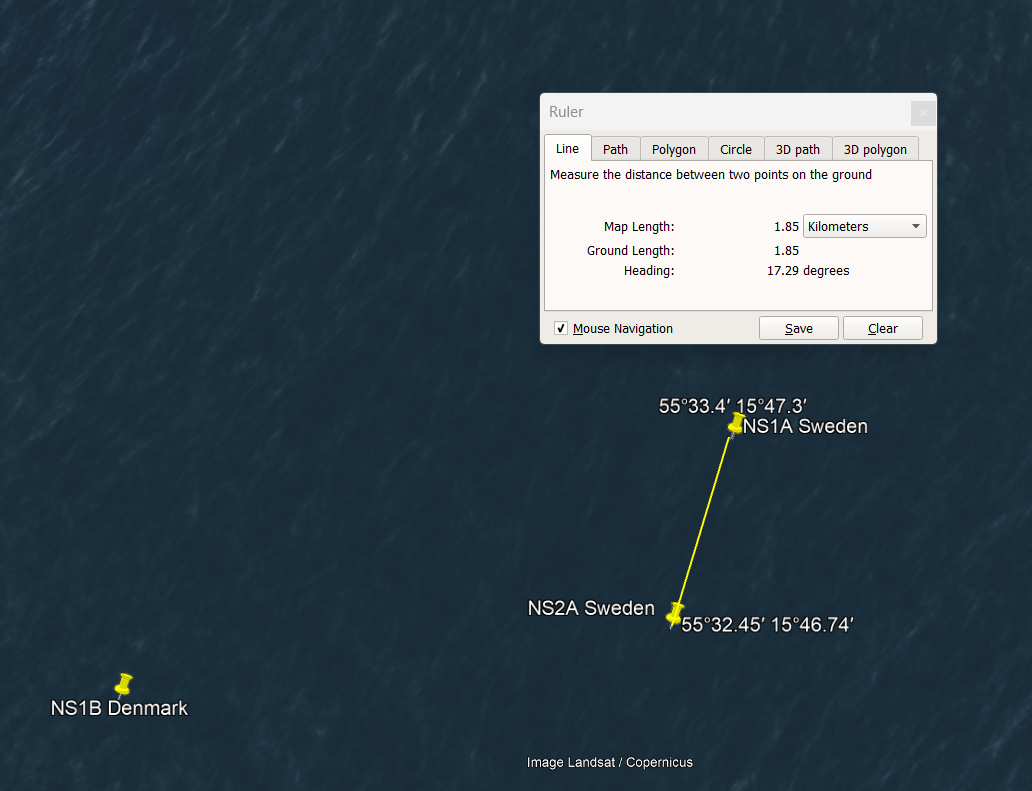
So in these 9 days at least four dives, maximum one per day per diver , were possible. At September 22 the yacht was in Wiek, the next day it was returned to the rental in Rostock. So in practice seven days were available for diving. Mind after a dive a period of 24 hours should be used to not dive to have the body recover. Assuming each dive had two divers, and only these two divers were on board, there were not many days available for diving. It is not possible for the divers with such heavy equipment to have 1 dive and place two explosions at two different locations. The shortest distance between two locations were explosions were is 1,86 kilometers.
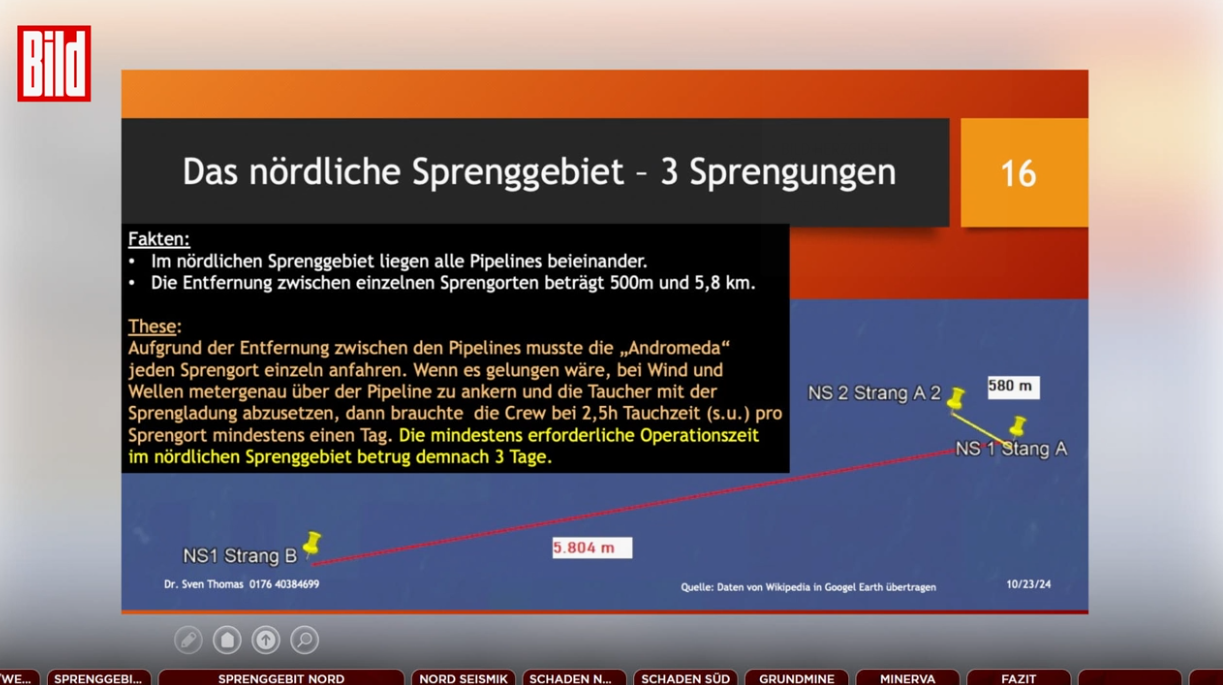
The distance shown by Thomas on his slides between two explosion sites is not correct.
He shows the distance as 580 meter. In fact it is 1,85 kilometer. Using the coordinates published by Wikipedia.
The biggest mistake
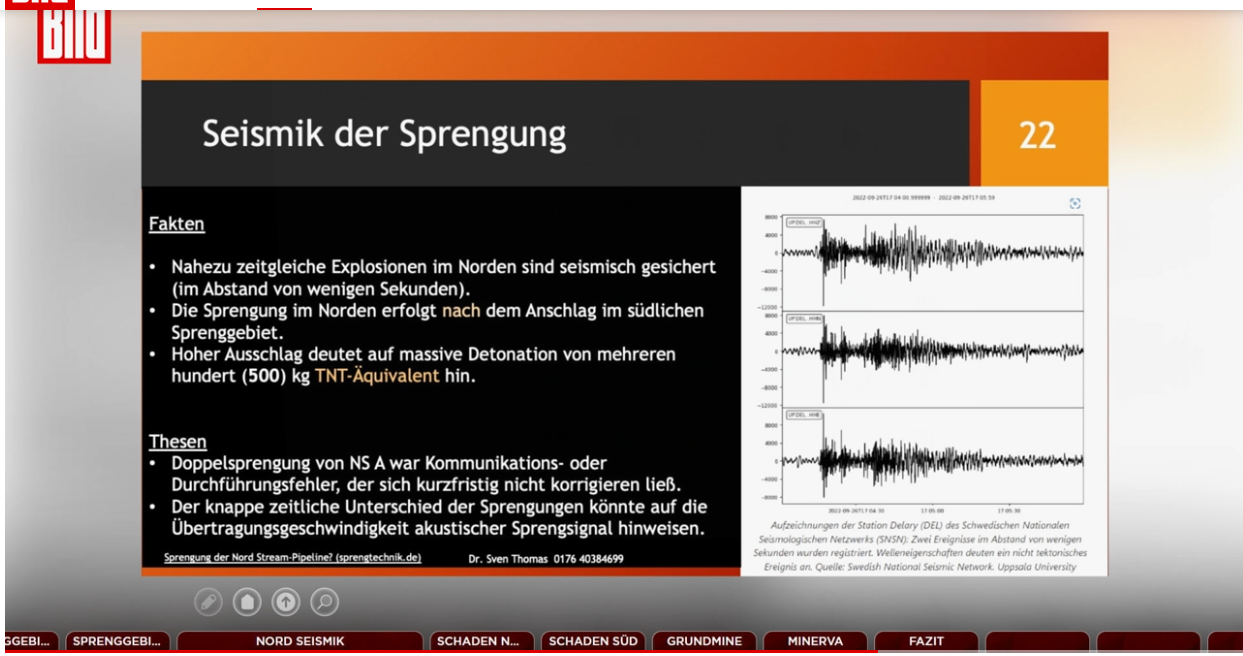
In the next slide Thomas makes his biggest mistake. He believes the force of the explosion measered by seismologic devices equals the required mass of the explosives. That is incorrect. The seismologic experts later calculated the mass of the explosives would be maximum 50 kilograms. The major part of the force of the explosion was caused by the high pressure in the pipeline. It is explained here. Thomas states a total of 1200 to 1500 kilogram of explosives was needed for just the three explosions in the north. It shows the lack of knowledge about this event. Earlier in the presentation it said 2.000 kg of explosives.
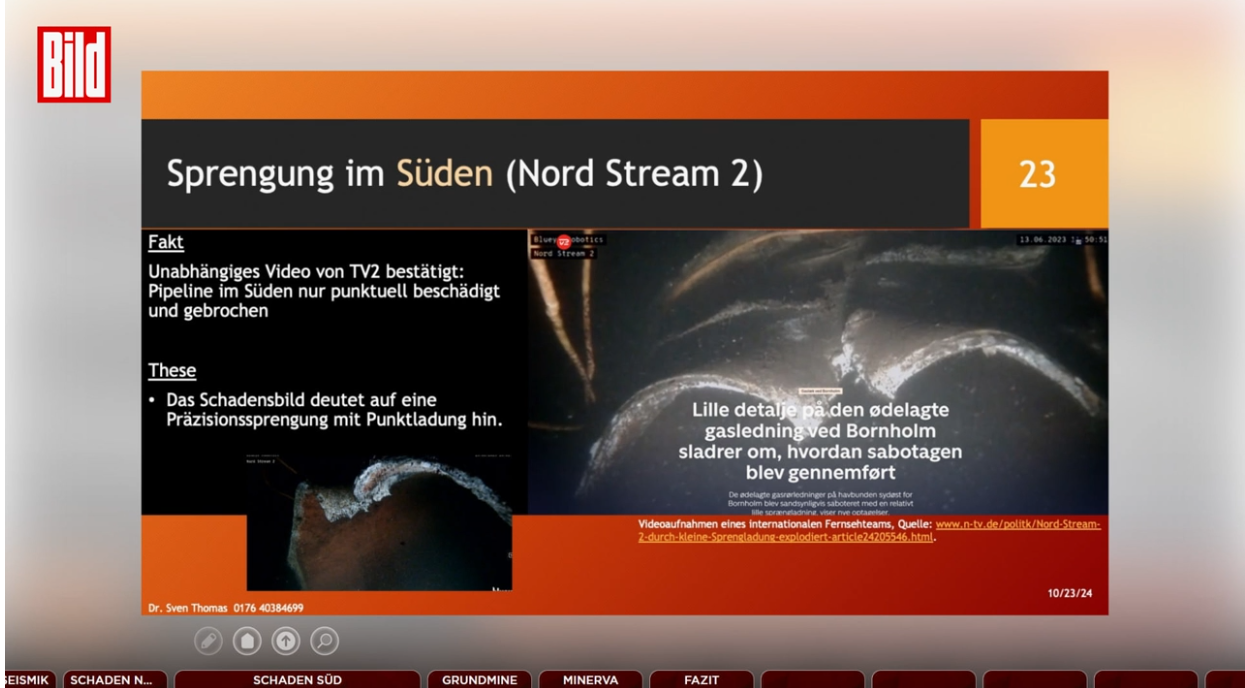
The next slide is about the damage pattern. Again Thomas makes a big mistake.
Remarkable is that Thomas states that the explosives used in the southern part had a mass of around 15 to 25 kilogram. He states the technology used at this location was different than in the three north locations according Thomas. The damage pattern at the south site looks according Thomas like the work of professionals.
In the print edition of Bild it says:
The shape of the destroyed pipelines differs significantly in the four explosions: “In the south, the damage is similar to that of a small explosive device placed directly on the pipeline, 20 to 25 kilos is enough for that.” The three detonations in the northeast of Bornholm, on the other hand, were much larger, but were further away from the gas pipes. There, the pipeline strands were “crushed like a tin can,” said Thomas.
Thomas believes the three explosions in the north were not caused by explosives placed directly on the pipeline but by heavy groundmines laid by a large ship. He mentions the name of the Greek oiltanker ‘Minerva Julie’
That is nonsense. The damage of the pipeline in the south is enourmous and very similar to two of the three damage patterns in the north side. One of the three damage patterns in the north is different. This can be explained because this pipeline was destroyed earlier by the explosion on the south side. An overview of the damage pattern of the sites can be seen here.
Conclusion;
Sven Thomas made many mistakes. He believes 1200 to even 2000 kg of explosions were needed. That is incorrect. There is much more damage on the southern location than Thomas shows.