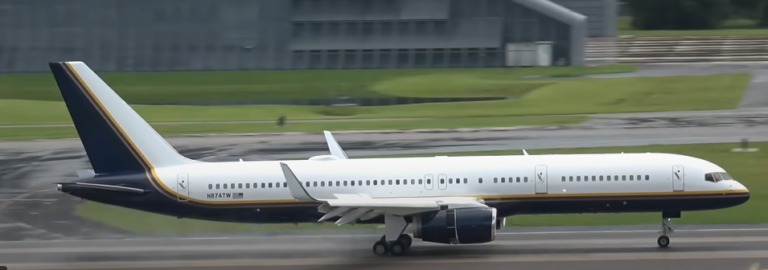
Von der Leyen’s Plovdiv Flight: Media Claimed GPS Jamming, Evidence Points to Human or Technical Error
After the aircraft carrying European Commission President Ursula von der Leyen deviated from its prescribed approach route into Plovdiv Airport, the Financial Times published a report suggesting the jet had been targeted by Russian GPS jamming. That article contained several factual inaccuracies. What was not disclosed at the time is that the journalist who wrote the piece was actually on board the flight. Nevertheless, the FT story was picked up and repeated worldwide by numerous media outlets — errors included.
The FT journalist who was on board this aircraft, Henry Foy, said in FT : The commission confirmed our reporting and confirmed that this was being treated as a suspected Russian interference operation.
The trip of Von der Leyen was designed to bring attention to the threat posed by Russia and the need for European governments to spend more on defence.
Independent analysis by this website suggests that the deviation was far more likely caused by human or technical error rather than GPS interference. Below is a reconstruction of events.
Financial Times did not correct its article after it was clear there were many errors in it. Euractiv wrote: When we asked them to respond to the inconsistencies in their reporting, they declined to comment on the record.
The Flight
The aircraft involved was a Falcon 900 business jet with Belgium registration OO-GPE operated by Luxaviation. It departed Warsaw en route to Plovdiv, Bulgaria. On approach, it was expected to follow a series of GPS-based waypoints, including one called RUMEN.
- 14:05:22 UTC – One of the two pilots first contacted Plovdiv ATC.
- ATC asked whether the crew could accept an RNP approach — a procedure that requires a functioning GPS signal. The pilot confirmed they could, proving GPS was working correctly at that point.
- 14:07:16 – The aircraft flew directly over waypoint RUMEN, again showing GPS navigation was normal.
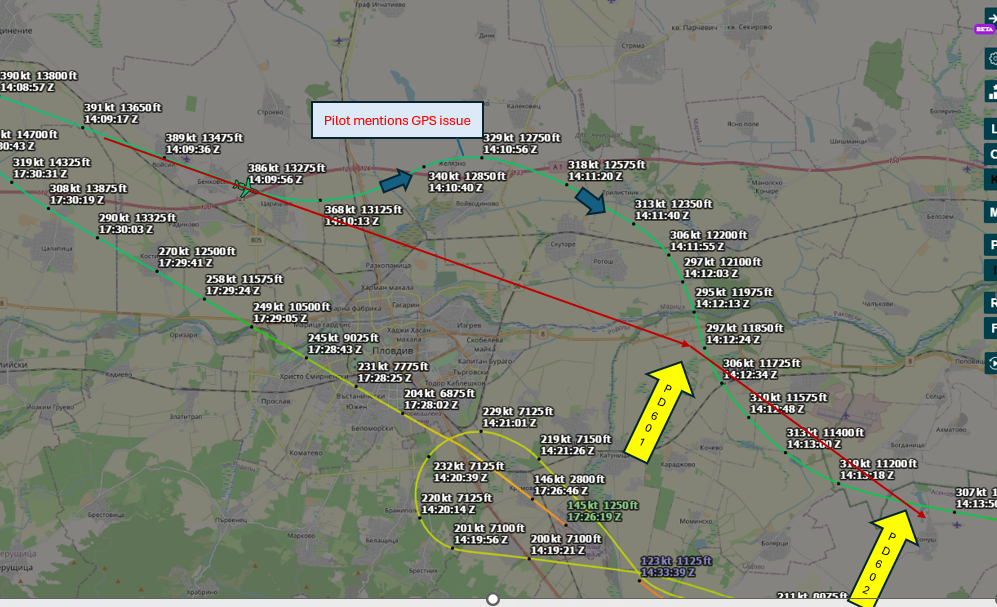
- 14:09:56 – The Falcon unexpectedly began a left turn not part of the published route.
- 14:10:53 – The pilot reported to ATC that there were “issues with the GPS.” The controller offered an alternate approach, but the pilot replied that they would ” try to continue with GPS navigation”.
- 14:13:15 – The crew requested to abandon the RNP approach and instead use the conventional VOR beacon for landing. The approach and landing were completed without further problems.
The red line depicts the prescribed approach path to Runway 30, which is designed to be flown using GPS navigation. The green line illustrates the track actually flown by the aircraft. What becomes clear is that for much of the approach, GPS navigation was functioning as intended. Even after the deviation, the jet still passed directly over the designated waypoints PD601 and PD602
Possible Explanations
Human error
One plausible explanation is a cockpit input mistake. On the Falcon 900, activating “heading mode” button on the boardcomputer instead of continue the lateral navigation would cause the autopilot to fly a previously set course rather than the prescribed RNP track. RNP procedures require pilots to continuously monitor progress on electronic charts, which may explain why the crew noticed the deviation after about a minute.
This document from the NASA Aviation Safety Reporting System shows multiple cases where a plane made an unexpected turn while on a GPS (RNAV) approach.
Another possible human error is this. During the approach to Plovdiv Airport, the aircraft was flying directly toward an abandoned air force base (Cheshnegirovo ). It is possible the crew initially mistook this for Plovdiv Airport. Both airfields have a single runway, and both are oriented in roughly the same direction. The pilots were undoubtedly aware of the risks of GPS jamming and spoofing in the region. They may have believed they had become victims of spoofing and initiated a left turn to reposition for a safer landing. To justify this maneuver after they realized their mistake, they reported a GPS issue to air traffic control.”
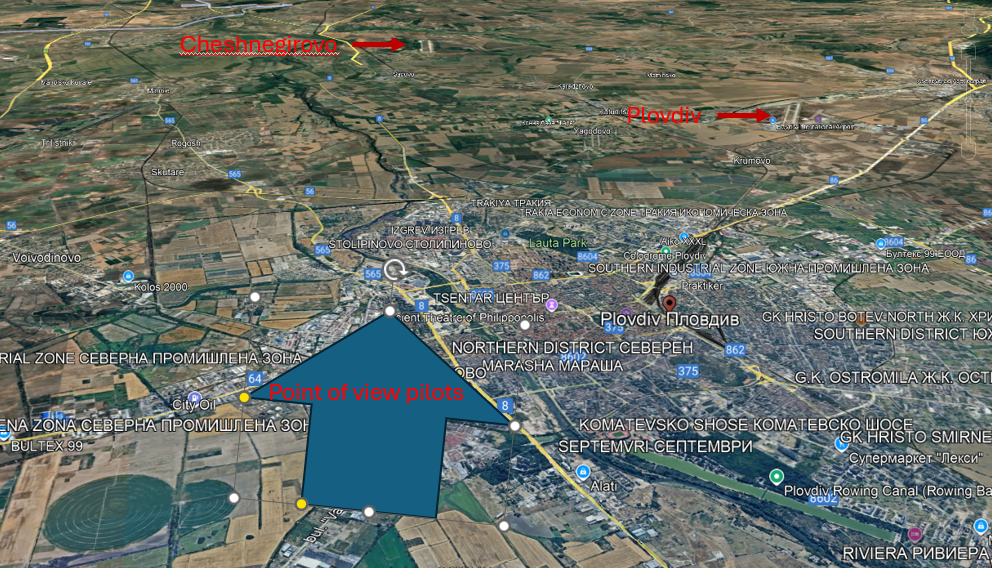
There was no reason for the pilots to make a left turn in order to avoid bad weather. Recordings of the conversations between the pilot and air traffic control show that ATC did not issue an instruction to make the left turn. Nor is there any approach procedure for the airport that would explain such a left turn. To the north of the prescribed RNP approach route, there are no other waypoints.
Technical issue
Another possibility is a database error in the navigation system. However, this is unlikely, as the waypoint database is widely used and such an error would almost certainly have been reported by other crews before.
GPS jamming or spoofing?
This explanation appears very unlikely. Only two and a half minutes before the deviation, GPS navigation was functioning flawlessly. Neither Flightradar24 nor ADSBexchange detected evidence of spoofing or jamming during the flight — although the day before, the very same aircraft had indeed shown clear signs of GPS spoofing.
Also a specialist company in monitoring GPS-disturbance called SkAI Data Services wrote on LinkedIn the aircraft was able to determine its position very precisely using GPS.

In this article by flight tracking service Flightradar24 (FR24), titled “Ursula von der Leyen’s flight to Plovdiv: what the data tells us” an explanation is given showing that the data indicates there was nothing wrong with the GPS signal. It also points out that on the previous day’s flight, clear effects of GPS interference were visible
If GPS had become unusable, the crew would have been forced to switch to IRS (inertial navigation), which is less accurate. In that case, ADS-B parameters such as NIC (Navigation Integrity Category) and NACp (Navigation Accuracy Category for position) would have dropped sharply. They did not. Throughout the flight, NIC and NACp values remained high, indicating consistently precise GPS positioning.
Inconsistent data ?
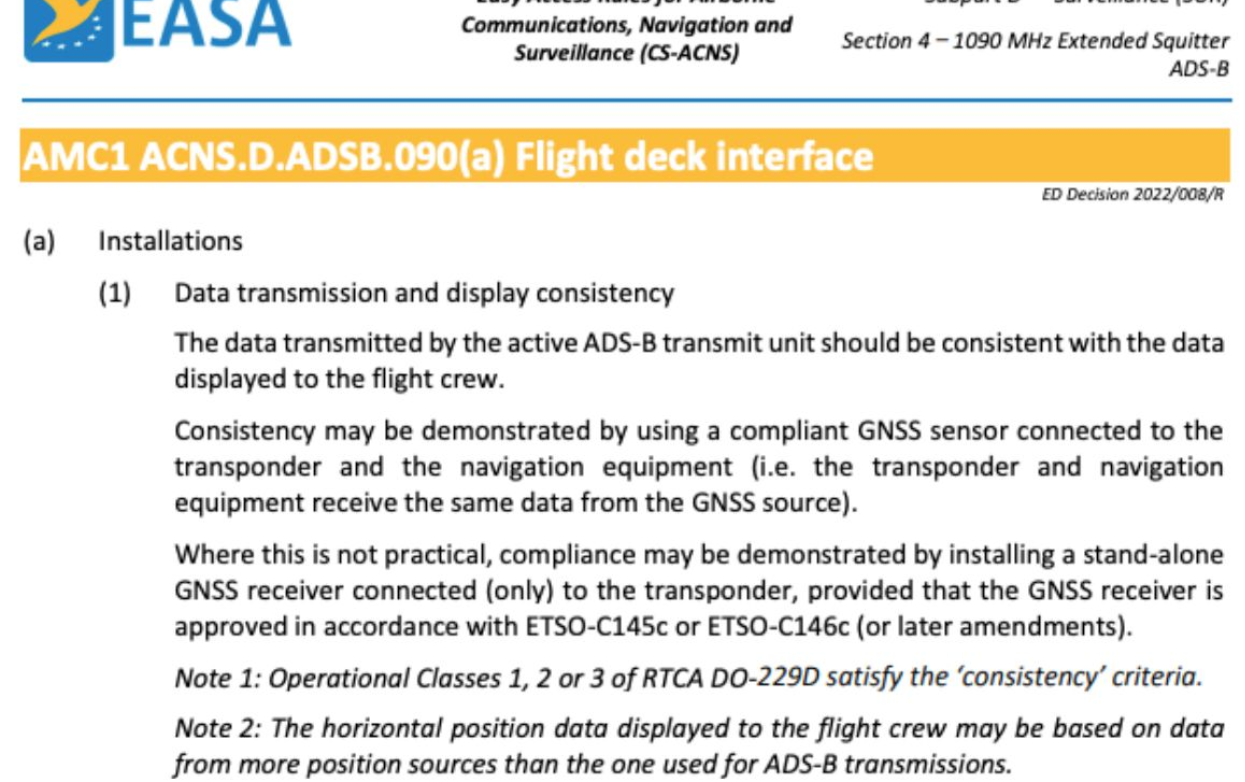
Another possibility is that the value representing the accuracy of the position, as transmitted by the ADS-B transponder, is higher than the accuracy value calculated by the onboard computer. However, this seems highly unlikely. An EASA document specifies that the data transmitted via ADS-B must be consistent with the data displayed on the pilots’ instruments. In other words: if flight trackers such as Flightradar do not show a GPS disturbance, then the pilot does not see one either.
Supporting Evidence
An animation by John Wiseman (@lemonodor), shared on the social platform BlueSky, shows the Warsaw-Plovdiv flight path. The majority of positional “ticks” are colored blue — an indicator of reliable GPS reception. Had GPS interference been present, multiple aircraft in the vicinity would have shown yellow or red indicators. The visualization also shows that von der Leyen’s jet flew through a “green zone,” where GPS reception was reported stable, while jamming was concentrated in yellow and red areas elsewhere.
Lack of motive
There is no plausible motive for a state actor such as Russia to deliberately disrupt the GPS signal used by Ursula von der Leyen’s aircraft for navigation. Moscow is well aware that such interference would serve no purpose. Yet some journalists went so far as to suggest the incident amounted to an attack. That is nonsense: every aircraft is equipped with multiple other electronic navigation systems, ensuring it can operate safely without GPS.
Conclusion
Despite headlines pointing to a deliberate Russian GPS jamming attack, the available evidence strongly suggests that the deviation of von der Leyen’s Falcon 900 was more likely due to human input error or a minor technical anomaly. The GPS signal itself remained robust, and flight data does not support the theory of targeted interference.