An overview of hybrid, electric and hydrogen powered new generation aircraft
Many companies are working on the development of a new generation aircraft. Aircraft with engines powered by electricity, hydrogen or a hybrid combination. Developing a new generation aircraft costs a lot of money and takes many years. Many companies have failed.
In this article we will provide an overview of the current landscape of companies working on new aircraft and engines. We will start the overview with companies who are already testflying new aircraft or are close to production. Then we will discuss the concept aircraft. Finally we will provide an overview of the pauzed and failed initiatives.
We will focus on aircraft with 5 seats or more. Very few aircraft with less seats are in production or close to production. The Pipistrel Velis Electro is a two seater in production since 2020. It has an EASA certification for CS-LSA category aircraft or ‘Light Sport Aeroplane’.The Chinese Liaoning General Aviation Academy four seater RX4E has been granted a type certificate for airworthiness at the end of 2024. It has a maximum flight time of 1.5 hours.
We also exclude in the article seaplanes like the Regent Seaglider and most of the electric vertical take-off and landing (eVTOL) aircraft.
We start the overview with the Archer Aviation Midnight. This is a five-seat eVTOL production aircraft which carries four passengers and one pilot for up to 60 miles (nearly 100 km). It completed its first flight in December 2021. This aircraft is designed to fly short routes from for example airports to downtime heliports. Abu Dhabi Aviation (ADA) will be Archer’s first Launch Edition customer, with plans to deploy an initial fleet of Midnight aircraft beginning later in 2025. Production is scheduled to start in early 2025 with a target goal of 2 aircraft per month by the end of the year. Eventually, this facility can scale up to a production rate of 650 aircraft annually by 2030. The aircraft made over 400 testflights.
Beta Technologies Alia CX300 is an all electric powered aircraft which can carry up to five passengers plus one pilot or 1,250 pounds of cargo. The CX300 prototype has demonstrated a range of up to 336 nm on a single charge in flight testing. The aircraft received airworthiness certification from the FAA in November 2024. Demonstration flights will take place in Norway and New Zealand in 2025.
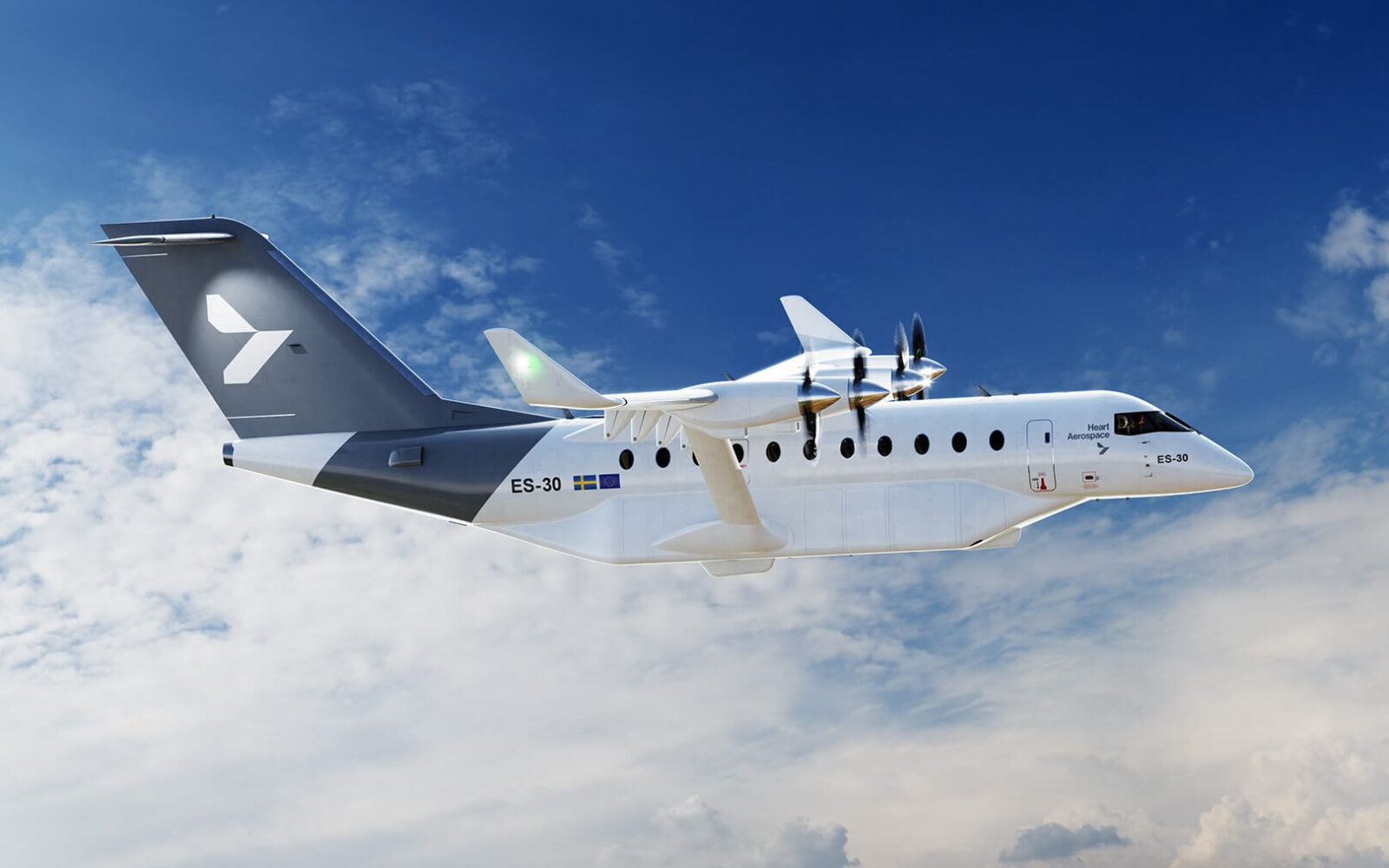
Heart Aerospace ES-30 hybrid
Initially, the Swedish built Heart X1 will be used for ground-based testing, focusing on charging operations, taxiing, and turnaround procedures. It is scheduled to undertake a fully electric first flight in the second quarter of 2025. Heart Aerospace has unveiled its first full-scale demonstrator hybrid-electric aircraft as it targets commercial flight by the end of 2029. The capacity of this hybrid powered (two electric engines, two kerosine powered) aircraft will be 30 passengers.
The Heart X2 is scheduled for a hybrid-electric flight in 2026 . Heart targeting type certification of the ES-30 by the end of the decade. In 2019 Heart stated the first commercial flight would be in 2025. As with many innovations deadlines are postponed.
California-based Ampaire developed a hybrid engine which can be installed in current aircraft. The company converted two Cessna Skymasters and a Cessna 208B Grand Caravan. This is called the Eco Caravan which has 9 seats. The Eco Caravan uses Ampaire’s AMP-H570 AMP Drive propulsion unit, comprising a 550-horsepower compression-ignition engine and electric motor. Both the engine and motor provide torque to the propeller directly. The Eco Caravan first flew in 2022. In 2023 the company expected FAA approval in 2024. In September 2024 the companty hoped to obtain FAA certification at the end of 2025. In January 2025 it was reported the FAA certification was expected by the end of 2026.
This is another example showing certification is extremely difficult and time consuming. Ampaire offers a retrofit on existing aircraft. So this is an indication of the time needed to design, built and certify a complete new aircraft.
Using state of the art batteries the endurance will be roughly 400 kilometres.
Aura Aero ERA (Electric Regional Aircraft) is set to make its first flight in 2026 and entry into service in 2028. Equipped with eight propeller engines, this hybrid-powered plane developed in France could carry up to 19 passengers or 1.9 tons of cargo, with a maximum range of 1,600 kilometers, providing a viable solution for regional routes. There is no concept/mockup aircraft yet build.
While new generation aircraft are hardly flying, electric and hydrogen engines are already tested on existing aircraft. An example is a company called ZeroAvia. The British-American firm has successfully test-flown a 19-seater Dornier 228 plane powered by two hydrogen-electric engines, and aims to enter it into service in late 2025.The ZA600 engines will power 10 to 19 seat aircraft.
Cranfield Aerospace is working on a conversion of a Britten-Norman Islander 9-seat aircraft from conventional fossil fuel to that of gaseous hydrogen propulsion. The aircraft will be able to seat 6 to 8 passengers with a range of 400 km and reserve. The test aircraft with registration G–HYUK did many testflights. Supplemental Type Certificate for the modification to be certified by 2026 . Entry into service is expected in 2027.
Jetcruzer International is developing the Jetcruzer 500E, a six-seat hydrogen-electric aircraft, with an entry-into-service target of 2028. The 500E is based on an existing aircraft model. So basically the traditional engine is replaced by an electric powered one supplied by ZeroAvia.
Italian Manta Aircraft is working on its Ann6 hybrid-electric aircraft . The start-up introduced a mock-up of the new six-seat design at the recent China Airshow in Zhuhai as it works towards the start of flight testing a full-scale prototype around mid-2026, with service entry projected by the end of 2028. It has a range of 300 km for VTOL operation and more than 1,000 km using a short airstrip for STOL operation.
Dovetail Electric Aviation is working on a hydrogen-electric powerplant. The powerplant developed by Dovetail will enable existing passenger and cargo aircraft under 20 passengers to be converted to serve regional routes. A Beechcraft King Air was modified with the engine however it is also suited to the Cessna Caravan, Twin Otter and Pilatus PC-12. Dovetail is developing an electric version of the popular Cessna Caravan, with 2026 as the target date for commercial certification. It estimates the range of its electrified Cessna 208 to be over 100km with a top speed of around 300km/hr and a payload of up to 950kg. First flight is expected in 2025.
A competitor of ZeroAvia is MagniX. This US company developed the magni500 750HP EPU electric engine. An aircraft can fly 160 km (100 mi) with 4-5 passengers while keeping reserve power using the magni500. The first testflight with this engine was on December 10, 2019. An Harbour Air Beaver seaplane was installed with this engine. It has since flown 90 test flights on its path towards full certification, expected sometime in 2026-27. The Beaver can fly 5 passengers for 1 hour. MagniX is working on the Magni650 electric engine which will be used on a Dash 7 aircraft.
French company Safran received in February 2025 a certification for its ENGINeUS 100 electric engine. It will be used for the VoltAero Cassio 330. Equipped with a 330-kW electric-hybrid propulsion unit, it will accommodate five seats. It is now scheduled to fly in the first quarter of 2025 with certification expected in 2025.
Electra EL9 Ultra is a nine passenger short takeoff and landing (STOL) hybrid aircraft with a range of 1100 nm. First flight is planned in 2025. FAA art 23 certification in 2029. The design for the production EL9 model was revealed in November 2024.
German H2FLY developed a hydrogen powered engine. The next step is to power a Dornier 328 with the engine. The 40-seat D328eco test aircraft is preparing for rollout before the Paris Air Show in June 2025. DLR developed the world’s first hydrogen fuel cell-powered four-seat passenger aircraft, HY4, which made its first flight in 2016.
Electron Aerospace is stepping up work to bring a five-seat (1 pilot and four passengers) all-electric aircraft to market by the end of this decade. The Dutch start-up unveiled an updated design for the Electron 5 model, for which it intends to start deliveries in 2028. The company aims to complete EASA type certification by the end of 2027.
Norway’s Elfly is working in the Noemi (meaning ‘no emissions’) electric aircraft. It is a seaplane with 9 seats. It is envisaged that the aircraft will enter service in 2030 with validation taking place from 2027 using a test aircraft. The aircraft is aimed to replace the current Twin Otter on floates seaplane. This aircraft is used by operators in for example the Maledives and Canada. Mind the Twin Otter has up to 19 seats.
Wright Electric successfully ran its electric 2.5MW motor. Wright plans to use its electric propulsion system to convert BAe 146 regional aircraft. The Wright Spirit will be capable of transporting up to 100-passengers for one-hour flights and is planned to fly for the first time in 2027.
The AirCraft Company is working on the SY30J Pangea aircraft. It will be able to carry 30 passengers with a 400 km zero-emission design range. It is an electric aircraft with hybrid to extend the range. Reveal of the aircraft design was at 6 February 2023 . The Entry Into Service (EIS) is planned for 2029.
German MD aircraft is working on the MDA1 battery electric aircraft with seats for up to nine passengers plus a pilot. Using state of the art batteries the endurance will be roughly 400 kilometres. MD Aircraft is assembling an iron bird ground test rig for its 10-seat MDA1 electric aircraft and aims to start using this to evaluate its design in early 2025. The company, which is a spinoff from German aviation engineering group MD Flugzeugbau, has said it aims to have a technology demonstrator flying by early 2027 as it works toward type certification and first deliveries by 2030.
Aircraft announced but not flying commercially before 2030
Dutch Conscious Aerospace is working on is working on electric motors based on water fuel cells as a retrofit for the Dash 8-300 turboprop. First flight using a modified Dash-8 is around 2030. Conscious Aerospace previously received an investment of 80 million euros from the Dutch government. In 2023 it was communicated that around 2028 passengers were flown with this retrofit.
German made VÆRIDION Microliner will carry 9 passengers and has a range of 400 km . The company aims to do test flights of its prototype in 2027, and by 2030 deliver its first planes to customers. It is has a single-propeller, multi-engine electric propulsion system, featuring a direct drive power transmission.
Cosmic Aerospace is developing its 24-passenger Skylark. An all-electric aircraft with a range of more than 600 miles on a single charge. Digital renderings released by Cosmic show what appears to be a total of 32 small engines distributed across the wing, with 16 on each side. The company intends to fly the first full-scale demonstrator aircraft in 2026, followed by a production-representative airplane in 2027, with certification and entry into service targeted for 2029. The company developed its own EP-1 engine.
France company Beyond Aero is developing a business jet, which it plans to launch in 2030. Beyond Aero’s One aircraft aims to be the first electric business aircraft powered by hydrogen propulsion. It can carry between six and eight passengers and travel up to 800 nautical miles. The company developed a 85-kW fuel cell/battery powertrain. It was installed on an G1 SPYL-XL ultralight aircraft which made several testflights.
Dutch startup Maeve Aerospace is developing the M80. A hybrid-electric 80-seater that could enter service by 2032. The range will be 1,200 nm.
Dutch startup Elysian E9X will travel up to 800 km direct with a fully electric regional aircraft, and space for 90 passengers, capable of reducing emissions by 90% — which it aims to fly commercially within a decade. First flight in 2030 and service entry around 2033.
Dutch Fokker Next Gen is developing an all new designed aircraft with 120 seats which will be powered by hydrogen. The engines will be traditional gasturbines. Expected to enter commercially in 2035.
Failed or pauzed projects
Many initiatives to produce electric or hybrid engines have failed, pauzed or were postponed. These are some recent examples.
Zunum Aero worked on a 6 to 12 seat electric aircraft . In 2018 the company went bankrupt as it failed to attract additional investors.
US-based aviation startup Universal Hydrogen went bust in 2024 after it failed to secure sufficient funding to continue R&D of its fuel cell-powered propulsion system and modular storage solution. It planned to have its hydrogen powertrain enter into service on a retrofitted ATR 72 regional aircraft during 2026.
Eviation stopped the development of the Alice aircraft. The aircraft did one testflight. It was supposed to carry up to 9 passengers.
Germany’s Volocopter has initiated insolvency proceedings
Tecnam P-volt programm stopped in June 2023.
German Lilium was working on the Lilium Jet. A German electric vertical take-off and landing (eVTOL) electrically powered airplane with seven-seats. In February 2025 the company filed for bankruptcy.
Airbus Helicopters is pausing plans to bring its four seats CityAirbus NextGen eVTOL aircraft to market. In 2024 a prototype made its first flight.
Airbus delayed its ZEROe programme, in which it had planned to launch a hydrogen-powered commercial airliner by 2035. According to the Financial Times, the timeframe could be pushed back by between five and 10 years and the budget for the programme has been cut by a quarter.