
Analysis of Learjet 35A N880Z crash at December 27 2021
At December 27, 2021 Learjet 35A N880Z crashed at 19:14 on short final for runway 27R at Gillespie Field near San Diego. Both pilots and two other people on board (both nurses, a Registered Nurse and Flight Paramedic ) died. Nobody on the ground was hurt. The aircraft was on a 20 minutes flight from Santa Ana John Wayne airport heading to its homebase Gillespie Field, El Jacon East of San Diego. The aircraft was completely destroyed when it hit a road and catched fire. It was operated by AeroMedEvac Air Ambulance. The flight likely was not a MEDEVAC flight but a positioning flight back to base.
Summary
N880Z likely crashed as result of an accelerated stall. The aircraft was flying VFR as this was the only legal way to get into the airport. On IFR a circling approach into 27R, the only runway available for the aircraft, was not allowed. While on baseleg and flying low the crew could not or hardly see the runway lights. Both pilots had just a few years experience on flying the Learjet 35A, an aircraft which can easily stall if speed is not closely monitored. Both pilots were flying together for a long time which creates a too friendly atmosphere in which one pilot does not criticise the mistakes of the other. Likely both pilots were looking the the runway and not on the instruments. They came close to Rattlesnake Mountain, tried to avoid it by too much banking and pull up at the same time, creating G-forces leading to less lift and the aircraft went into an accelerated stall.
Crew
The names of the pilots are Douglas James Grande (09/16/1976) and Julian Jorge Bugaj (08/16/1954). Grande’s Linkedin page states that he was a captain with medical transport company Aeromedevac, and had been with them since May 2019, also working as a first officer.
Bugaj has a COMMERCIAL PILOT certificate (Commercial pilot licence) dated 5/14/2019 and has a single type rating for a Learjet. C/ LR-JET which means Bugaj was allowed to fly all Learjet 20 series, all 30 Series and Learjet 55. The certificate says Learjet SIC privileges only. SIC stands for SIC is second in command time. This is time you log when you are operating as a First Officer on an aircraft that requires two pilots. The daughter in law wrote this about Bugaj:
Bugaj has a COMMERCIAL PILOT certificate (Commercial pilot licence) dated 5/14/2019 and has a single type rating for a Learjet. C/ LR-JET which means Bugaj was allowed to fly all Learjet 20 series, all 30 Series and Learjet 55. The certificate says Learjet SIC privileges only. SIC stands for SIC is second in command time. This is time you log when you are operating as a First Officer on an aircraft that requires two pilots. The daughter in law wrote this about Bugaj: “Jorge has been an aviation enthusiast for decades. Starting from gliders, working his way into becoming a CFI (Certified Flight Instructor for AIRPLANE SINGLE ENGINE ) and as of the last few years he’s been flying Learjets for Aeromedevac.”
Grande has a AIRLINE TRANSPORT PILOT certificate with date of Issue: 6/13/2020 with type rating A/LR-JET. There is a remark in the FAA database saying ‘”SUBJECT TO PILOT IN COMMAND LIMITATIONS”. This means when you get your first type rating in a simulator and don’t have a certain number of turbine/jet hours, you will have a “SUBJECT TO PILOT IN COMMAND LIMITATIONS” limitation.
Industrial pilot and flight teacher Robert Katz was quoted in USA News Lab in explaining the subject to pilot in command limitations:
On Grande’s pilot certificates, there’s a notation that states that the Learjet is topic to pilot-in-command limitations: an ambiguous assertion that Katz mentioned would require extra analysis.
“But it could be such things such as restricting his authorization to fly at night, to fly in certain weather minimums, to conduct circling approaches, circling maneuvers… any number of things,” he mentioned.
Katz careworn that, at this level, it isn’t recognized what these precise limitations are.
“But the fact that they do exist, and given the nature of his incident as we know it so far, it strikes me as a bad mix,” Katz mentioned
Douglas Grande had worked at Aeromedevac Air Ambulance for less than three years, serving as a first officer from May 2019 – Dec 2020) and as a captain (May 2019-present) , according to his LinkedIn page. Prior to that, he worked for 17 years at an aviation manufacturing company called Quality Controlled Manufacturing, Inc.
According this post at PPrune.org, website used by pilots and armchair wannabee pilots. “the FO was PF and on the radio. The crew had been paired together for many months and had flown quite a few hours in December.
Flying together on many flight can be an issue. someone on Pprune wrote:
My worst mistakes have been when I’ve been flying with someone I got on really well with. Over familiarity can lead to complacency, and not wanting to pick up the other’s mistakes for fear of spoiling the nice atmosphere. And probably less effective briefings, and over confidence in the other pilot’s ability leading to poor monitoring.
That would mean Julian Jorge Bugaj was he first officer (FO) and pilot flying (PF) . He was very likely the pilot with the least experiece on the Learjet.
The aircraft approached the airfield from the north. It was doing a RNAV GPS approach for runway 17 and was cleared to land. With the airport in sight the pilot requested to cancel the IFR-flightplan and continue to fly VFR. ATC again stated ‘ clear to land ‘ but the pilot requested 27R to land.
The Learjet could not land on 17 as the runway was not long enough for the type. The wet conditions were also a reason to use the other runway. ADSBexchange shows that this aircraft and other Learjets operated by Aeromedevac never uses runway 17, even when the hangar is much closer to runway 17 than to 09L/27R.
The approach carts are here
So likely the crew never wanted to land on 17. At Gillespie at night it is not allowed to perform a circle to land procedure for 27R. By requesting VFR the crew could still legally circle to land to 27R. Probably the crew never considered 09L as this runway is hardly ever used. They likely, despite the weather, felt more comfortable with 27R. There is a RNAV straight-in approach to RWY 9L but this is not available for Category C and D aircraft. According to the FAA Aircraft Characteristics Database, the Learjet 35A is a Category D aircraft, approach speed of 143 kts.
The category of an aircraft says what the aircraft’s turn radius is which depends primarily on its bank angle and TRUE airspeed. Category D means the aircraft will have to make wider turns than a Category A aircraft. This is relevant for a circling approach as explained in this blogpost. Why the stall speed increases with the bank angle is explained here.
Two Nest doorbel camera’s recorded the last seconds of the aircraft. “
Aviation-Safety.net has a visual showing the flightpath.
A circling approach or circle to land is according to Skybrary “:
When an aircraft intends to land on a runway for which no instrument approach procedure exists, it may descend on the instrument approach to another runway and, provided the required visual references are established at the circling Minimum Descent Altitude/Height, manoeuvre visually for landing on the desired runway. This procedure is used when landing on the instrument runway is undesirable, due for example to wind conditions or work in progress.
The runways at Gillespie airport do not have approach lights. The only light available to mark where the runways are the lights on both sides of the runways.
Weatherconditions
It was a cloudy, misty evening with moderate visibility arond 3 nm and low clouds.
KSEE 280355Z VRB05KT 3SM BR SCT011 BKN020 11/09 A2996
KSEE 280255Z VRB05KT 3SM BR BKN020 OVC026 10/08 A2998
The aircraft flew the GPS approach towards the field because of the cloud. A circle to land was the intention. For this procedure the IFR flightplan is cancelled as soon as the crew is visable with the airport. However the crew had difficulties to have a clear sight on the ground. One of the pilots requested the ATC to turn up the lights. They are at 100% ATC responded”.
The crew likely was very busy trying to find their location relative to the airport and forgot to watch their instruments. They were flying a bit lower than normally to remain below the clouds. When the base to final turn was started likely the ground proximity warning system started to alarm the crew of the Rattlesnake mountain coming very close. The crew responded by increasing the trust of the engines, climbing but the banking angle was too much and the aircraft stalled. A Learjet 35A is limited to 20 degrees of bank full flaps and landing configuration.
View on runway 27R at night
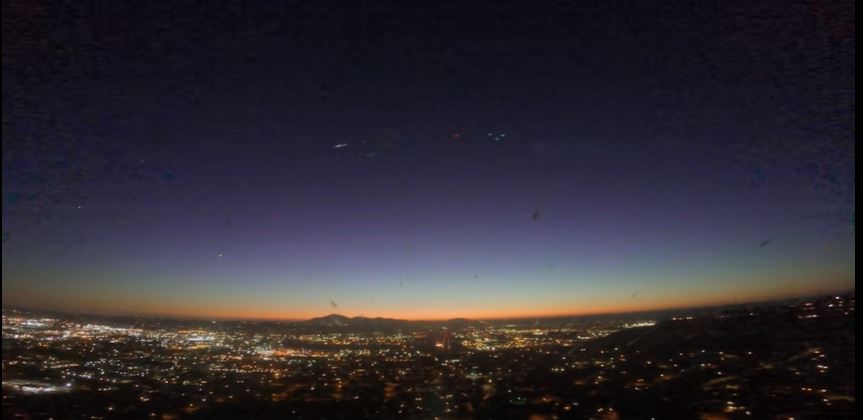
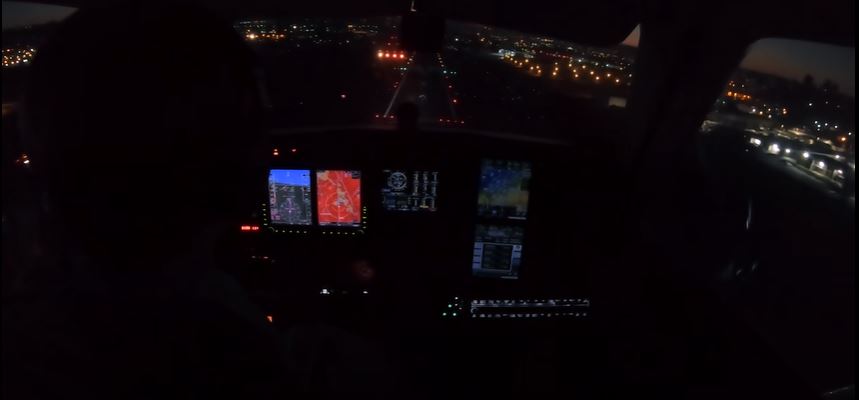
To get an impression of how runway 27R looks at 10 miles visibility at night I included in this post two screenshots of this video. The video was made by pilot Matt Guthmiller who flew a Bonanza to Gillespie Field and landed in the dark at 27R. This runway does not have approach lights. Think about night as well as low clouds poor visibility Pilots will not see the runway lights and an approach is more or less based on what the crew knows about position of landmarks.
This screenshot shows the view of the position where N880Z turned base to final. It is less than a minute before landing. I do not know what the intensity of the runways lights was.
And this screenshot shows the view from seconds before landing. Mind the runway lights are hard to see. Again the intensity of the lights is now known.
Rattlesnake Hill
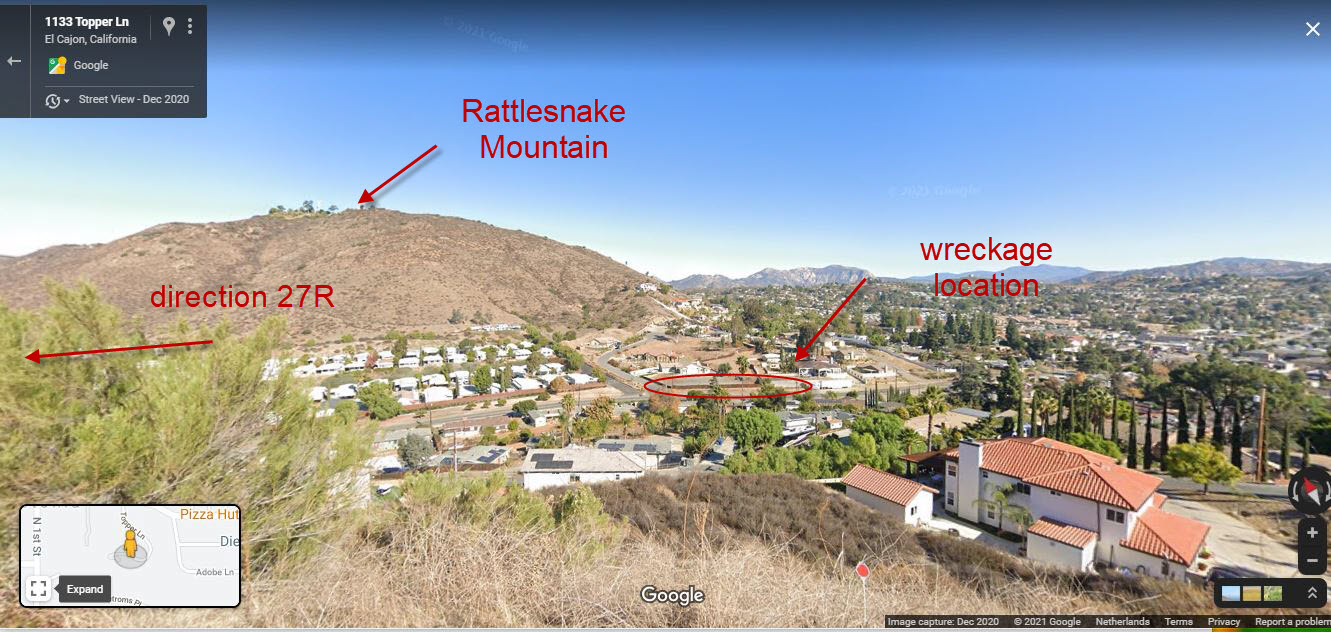
Just north/east of the threshold of 27R is a hill called Rattlesnake Mountain. From a hill closeby Rattlesnake Mountain looks like this. The Elevation is 1198 feet, 365 meters. When the aircraft was heading towards the Rattlesnake Mountain the altitude was just 900 feet. Much lower than the peak of the hill.
Instead of performing a missed approach the aircraft continued towards the left to avoid the mountain and to arrive at the airport. however the base to finale turn was too tight and the aircraft lost the lift of the wings.
Previous circle to land approaches by N880Z
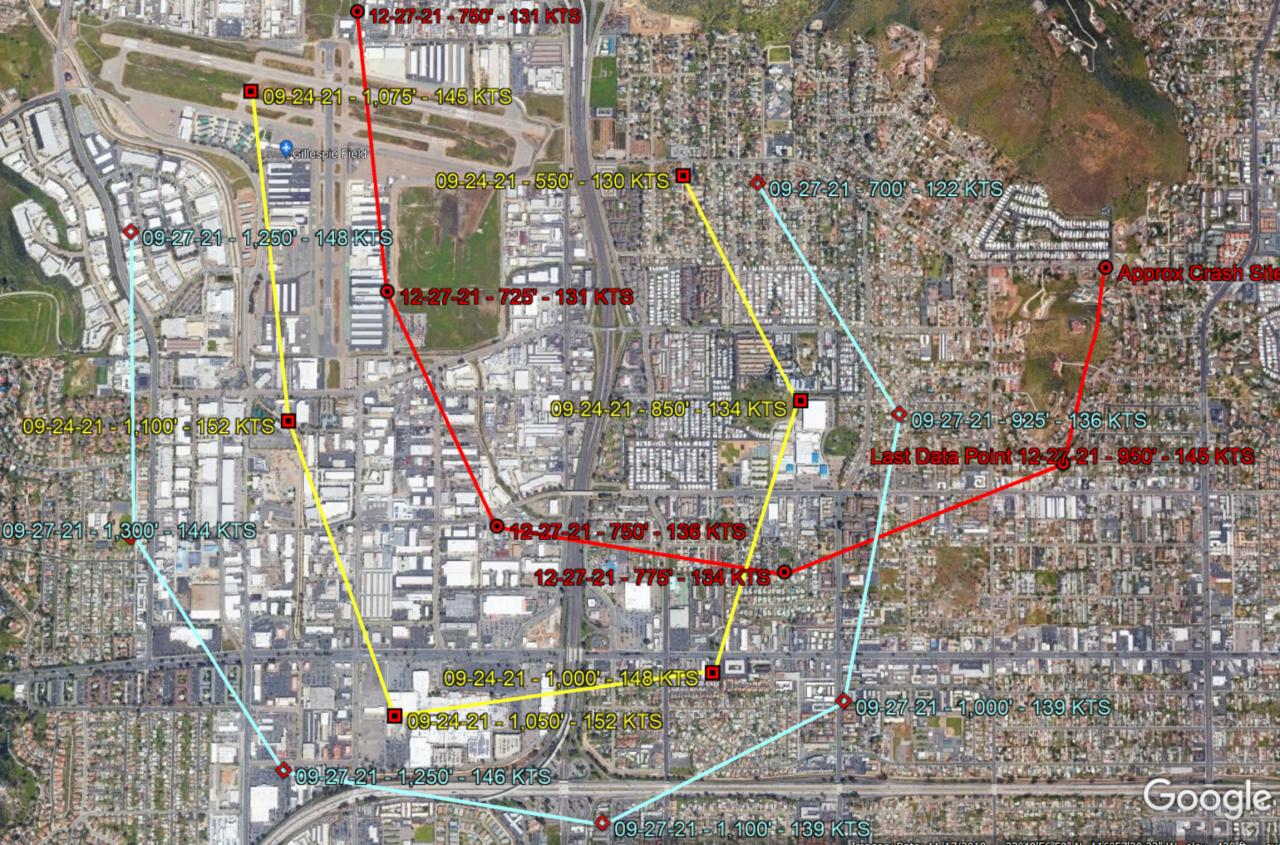
N880Z did a couple of other circle to land landings when it came in from the north of the airport. However the aircraft was more towards the west of runway 17 and made a turn avoiding heading towards Rattlesnake Hill. The fatal flight and two others are displayed in this image.
these are the URLs for the ADSBexchange tracks
https://globe.adsbexchange.com/?icao=ac2014&lat=32.822&lon=-116.965&zoom=14.0&showTrace=2021-09-25&leg=2×tamp=1632544625
https://globe.adsbexchange.com/?icao=ac2014&lat=32.822&lon=-116.965&zoom=14.0&showTrace=2021-09-27&leg=2×tamp=1632706201
https://globe.adsbexchange.com/?icao=ac2014&lat=32.822&lon=-116.965&zoom=14.0&showTrace=2021-09-28&leg=1×tamp=1632791832
https://globe.adsbexchange.com/?icao=ac2014&lat=32.822&lon=-116.965&zoom=14.0&showTrace=2021-12-28&leg=2×tamp=1640661159 (Crash)
Aeromedevac fleet
Aeromedevac ambulance aircraft fly around the US to transport patients from one place to another. Mostly because the patient has a good insurance and wants to be moved to another hospital. Aeromedevac also performs transportation of donor organs.
The fleet of Aeromedevac consisted before the crash of at least three aircraft. Besides Learjet 35A N880Z which crashed, also Learjet 35A N94GP and Learjet 31A N36BL were operating for Aeromedevac. It is interesting all three aircraft are owned by a different company. And all three companies have the same owner. N880Z was owned by MED JET LLC, N94GP is owned by JR AVIATION LLC and N36BL is owned by GO FAST AVIATION LLC . The owner is Richard J. Jones, who is listed as the chief pilot of Aeromedevac.
The Learjet 35A
Many pilots commenting on social media who have experience with flying the Learjet state it is a difficult to fly aircraft. It does not like slow speeds, it can stall at high banking angles. The aircraft has small wings, with small flaps and no slats. The fueltanks at the wing ends can cause problems with balance. Both pilots have just a few years of experience on flying the Learjet. It could be one of the causes of the crash.
Other approaches by aircraft operated by Aeromedevac
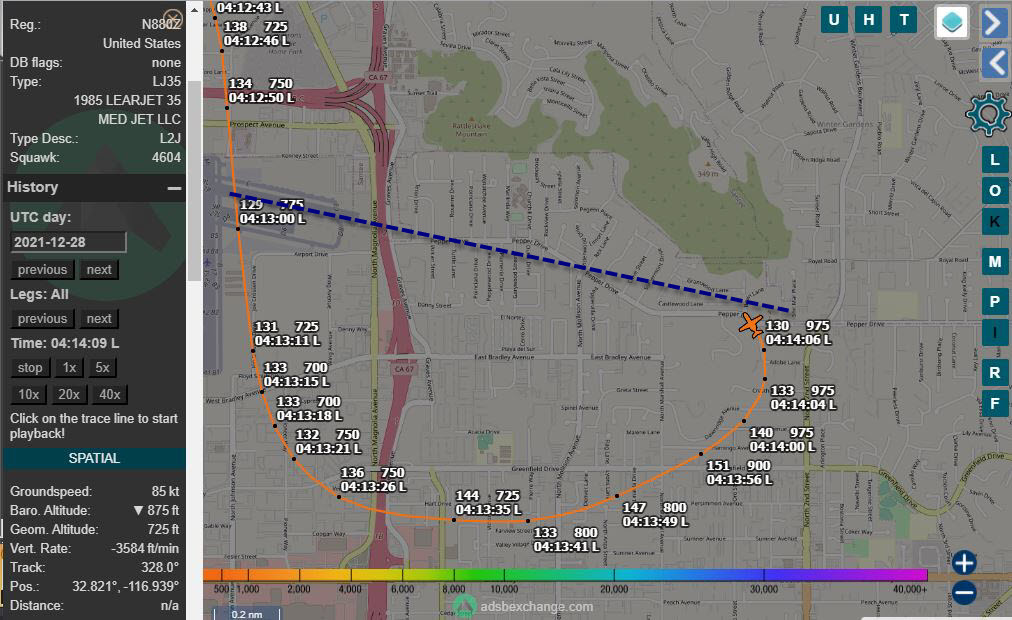
While N880Z made the turn when heading over the field southwards towards the east much to early, which resulted in the tight base to final turn, which caused the crash because of the bank angle it is interesting to see how other flights performed the same circling to land coming on from an approach of 07.
First the fatal flight of N880Z. The turn towards the east was started abeam the threshold of runway 35. The dotted blue line shows the extended centerline of 27R.
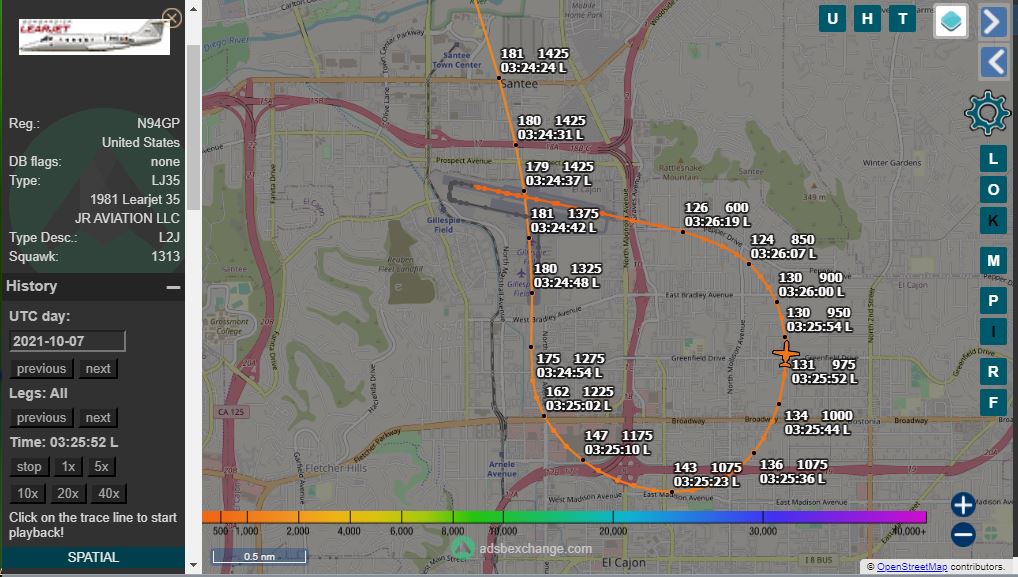
Now compare this to the approach of Learjet 35A N94GP which also operated for Aeromedevac. At October 7, 2021 the aircraft did a similar circle to land, approaching 17 then made a leftturn towards the base of 27R and making the base to final turn. The turn was initiated almost 4000 feet more to the south than the fatal flight of N880Z. The base to final turn was done about 2800 feet earlier than N880Z did.
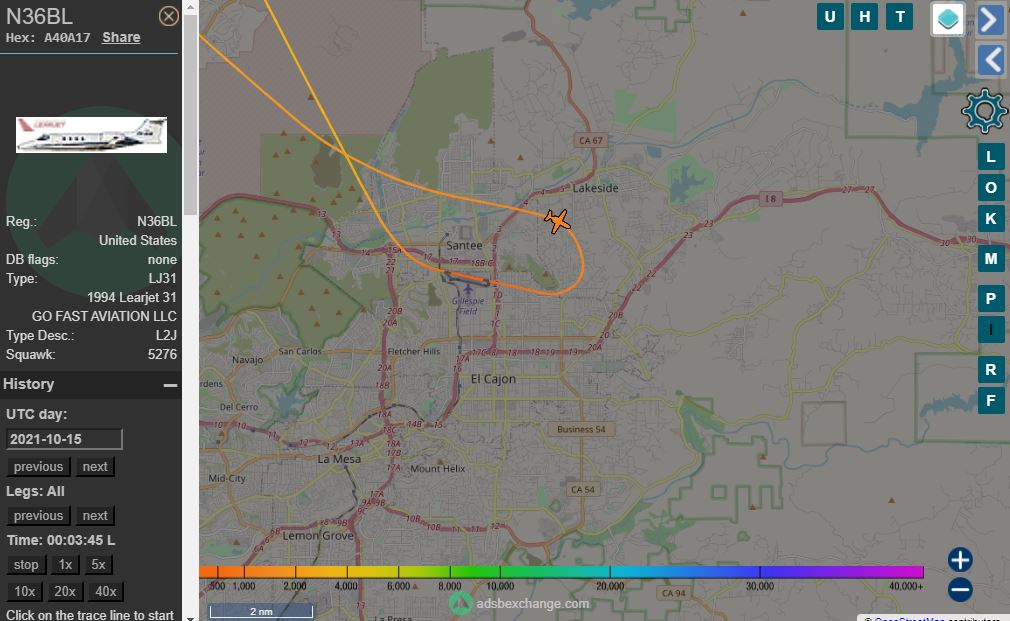
Learjet 31 N36BL is also operating for Aeromedevac. It is owned by a company called GO FAST AVIATION LLC which has Richard Jones as owner. In many approaches from the north it just once did a circle to land procedure overflying the field and then a left turn for downwind. This was at October 21. The downwind was long and much further south than N880Z did on its fatal flight.
All other approaches in recent months from the north had a downwind north of the runway 27R. Below is an example. More approaches of N36BKL can be seen at this page.
Similar crashes
There are multiple other crashes of business jets which crashes on the base to final turn while performing a cirlce to land procedure.
Learjet 35A N452DA crashed when doing a circle to land at Tetterboro.
In February 1991, Learjet 35A N535PC crashed shortly before landing. While overhead Aspen, the crew requested a right downwind circling approach to runway 15. The airplane was observed in a steep right bank on base leg. It overshot the extended runway centerline and entered a steeper right bank to correct back to the runway centerline. The Learjet stalled and crashed. The final, rather short, report of the NTSB is here.
BOMBARDIER INC CL-600-2B16 N605TR crashed at July 26, 2021 while on approach for runway 11 at Truckee. The aircraft overshoot the extended centerline of runway 11. The NTSB preliminary report is here.
Learjet 35 N781RS crashed at Dec 28, 2005 at Truckee airport. The airplane collided with the ground during a low altitude, steep banked, base-to-final left turn toward the landing runway during a circling instrument approach. The airplane impacted terrain 1/3-mile from the approach end of runway 28, and north of its extended centerline. The operator’s flight training program emphasized that during approaches consideration of wind drift is essential, and a circling approach should not be attempted in marginal conditions.
probable cause: The pilot’s inadequate compensation for the gusty crosswind condition and failure to maintain an adequate airspeed while maneuvering in a steep turn close to the ground.
Hawker 125-700 N237WR crashed on short final during an unstabilized nonprecision approach for Akron Fulton International Airport. The crash occurred on rainy day with a low cloud cover. The probable cause of the accident was “the flight crew’s mismanagement of the approach and multiple deviations from company standard operating procedures [SOPs], which placed the airplane in an unsafe situation and led to an unstabilized approach, a descent below minimum descent altitude without visual contact with the runway environment and an aerodynamic stall.”
Gulfstream III N303GA N781RS crashed at December 28, 2005 on short final for Aspen airport. Probable cause: The flight crew’s operation of the airplane below the minimum descent altitude without an appropriate visual reference for the runway. Contributing to the cause of the accident were the Federal Aviation Administration’s (FAA) unclear wording of the March 27, 2001, Notice to Airmen regarding the nighttime restriction for the VOR/DME-C approach to the airport and the FAA’s failure to communicate this restriction to the Aspen tower; the inability of the flight crew to adequately see the mountainous terrain because of the darkness and the weather conditions; and the pressure on the captain to land from the charter customer and because of the airplane’s delayed departure and the airport’s nighttime landing restriction. NTSB report here.
Websites covering the crash
Several people commented on this crash. For example Juan Browne of the Blancolirio youtube channel.
Airliners.net forum
Dan Gryder’s video https://www.youtube.com/watch?v=8pS17RPgqfI
Max Tresscot Aviation News Talk
Pilots of America forum
Pprune.org forum
AOPA Air Safety Institute makes a preliminary assessment of the accident,
This is a very good analysis of what happened that fateful night for the crew of N880Z