A MD-83 flew illegaly in North Atlantic airspace with not the right equipment
At May 21 a MD-83 crossed the Atlantic Ocean without the required equipment while on a ferry flight from the United States to Kyrgyzstan.
N984TW flew Roswell to Goose Bay at May 20. Then Goose Bay to Prestwick at May 21 and continue to Varna the same day. At May 22 the aircraft flew Varna to Bishkek as final leg for delivery to the new operator TezJet. The aircraft will be registered EX-80017.
This aircraft was the last MD-83 ever built. The aircraft was owned by a company with just two employees called WORLD AVIATION SERVICES LLC. The company is based near Opa Locka airport in Miami. The president of the company is David Gonzalez and the owner is Julio Ramos Maza. The company owned several aircraft in the past like N170AE Boeing 737-300 and N180AE, Boeing 737-300.
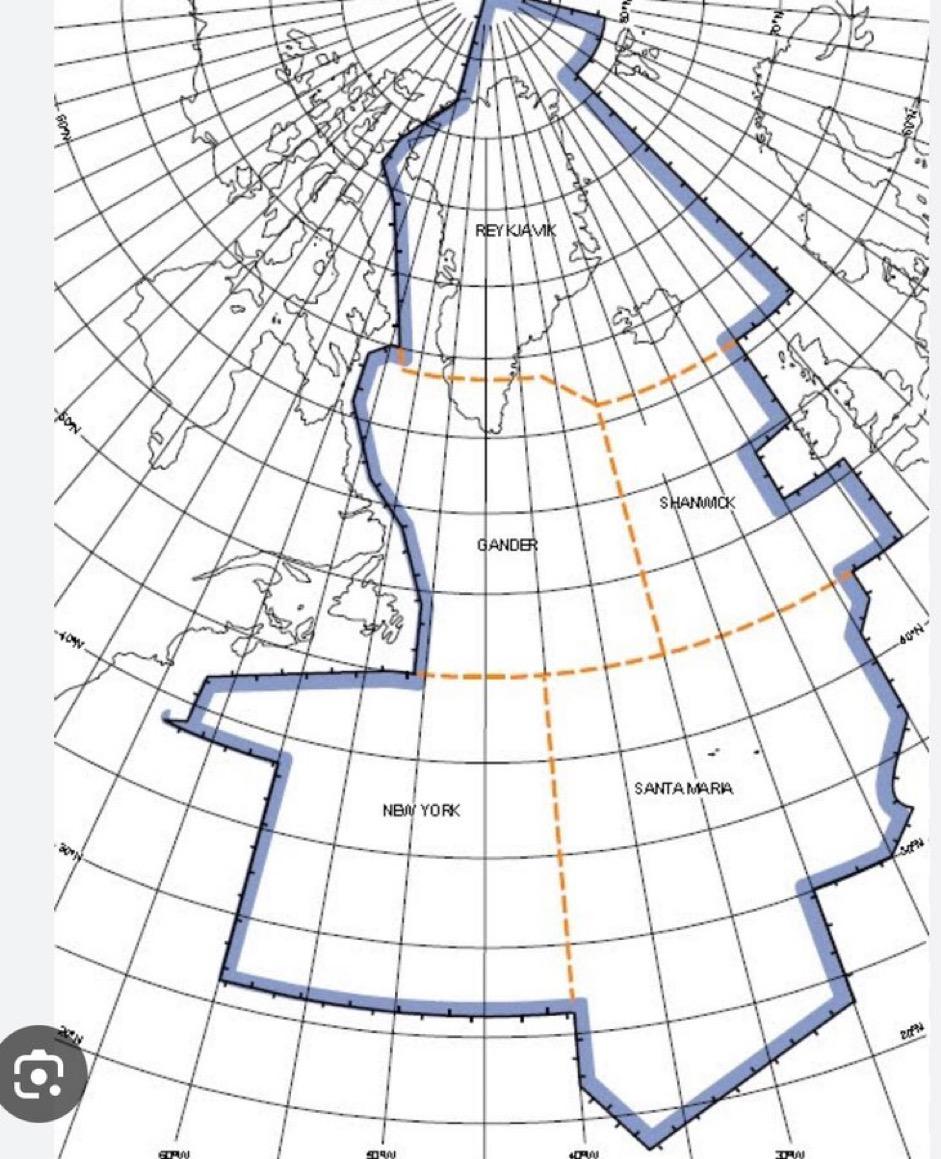
The aircraft crossed the Atlantic Ocean in an airspace and at an altitude which is named as ‘ North Atlantic High Level Airspace’ or NAT HLA. To use this airspace at Flightlevel 270 or above the aircraft has to have certain equipment installed. That is because this airspace does not have primary radar coverage. Also radio communication by voice is limited in this area due to distance between ground stations and aircraft.
The image below shows the NAT HLA airspace with the boundaries.
For an aircraft flying in this airspace above Flightlevel 270 the aircraft needs to have CPDLC , ADS-C and be RVSM-certified.
CPDLC stands for Controller–Pilot Data Link Communications. It is a digital communication system used between air traffic controllers and pilots, primarily for use in oceanic, remote, or busy airspace where traditional VHF voice communication is not practical or efficient.
Given its age and the cost associated with such upgrades, it’s unlikely that this aircraft has been equipped with CPDLC.
The MD-83 was designed before the implementation of ADS-C technology and, therefore, did not include such equipment in its original configuration. Given the aircraft’s age, original design specifications, and lack of evidence for retrofitting, it is highly unlikely that N984TW possesses ADS-C capabilities.
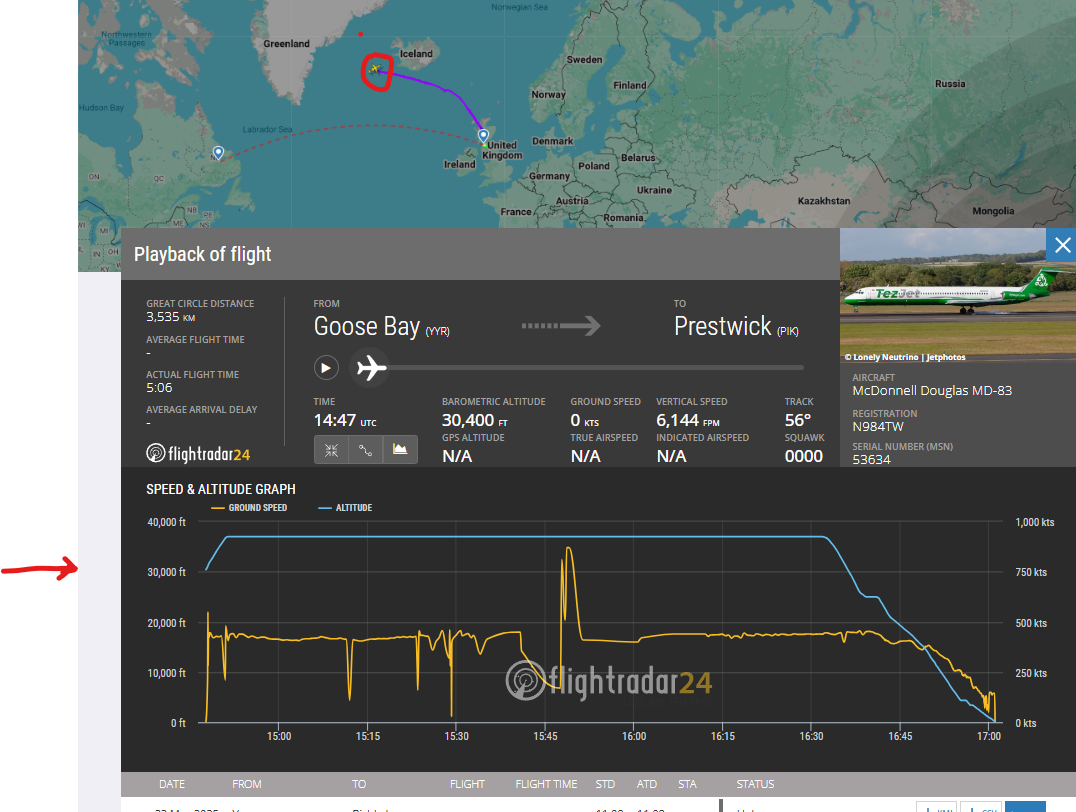
There is a special corridor for aircraft not meeting NAT HLA requirement. However the aircraft still needs to be equipped with ADS-B equipment. Based on the Flightradar24 data we know the aircraft does not have ADS-B equipment.
More information on the corridor is written in the ICAO update of their NAT Doc 007 – the main guidance doc for ops over the North Atlantic. This article has some good info.
The MD-83 is equipped with a single Long Range Navigation System (LRNS).
A requirement for aircraft crossing the Atlantic at FL270 or below is the need for HF 8.33 kHz radio equipment for communication with ATC. Likely the aircraft had a temporary installation of such radio.
The transponder
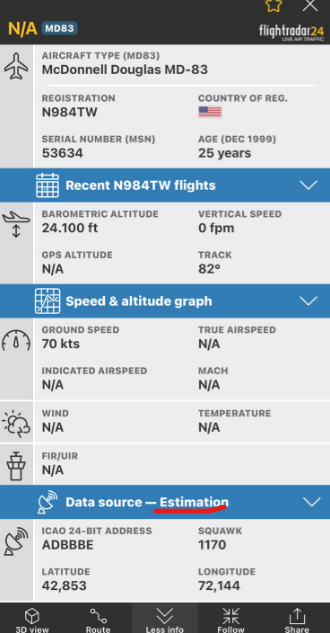
The aircraft only has a Mode A/C or Mode S transponder. This means the transponder can broadcast altitude, ground speed, heading but not its position. Flighttrackers like Flightradar24 uses a technique called MLAT to determine the position of the aircraft. This is shown by the flightradar24 data. Aircraft equipped with ADS-B at the Data Source: ADS-B. N984TW shows ‘ Estimation’
RVSM
RVSM stands for Reduced Vertical Separation Minimum — a set of standards in aviation that reduces the vertical separation between aircraft from 2,000 feet to 1,000 feet between FL290 and FL410 (flight levels 29,000 to 41,000 feet).
When flying in NAT HLA at FL370, as N984TW did, the aircraft is required to be RVSM-certified. The aircraft can only be certified when it meets multiple requirements on available equipment. Most MD-83s are not certified for RVSM, unless modified.
The FAA database does not show N984TW as RVSM-certified. In the database there are around 10 MD83 certified.
The flightpath
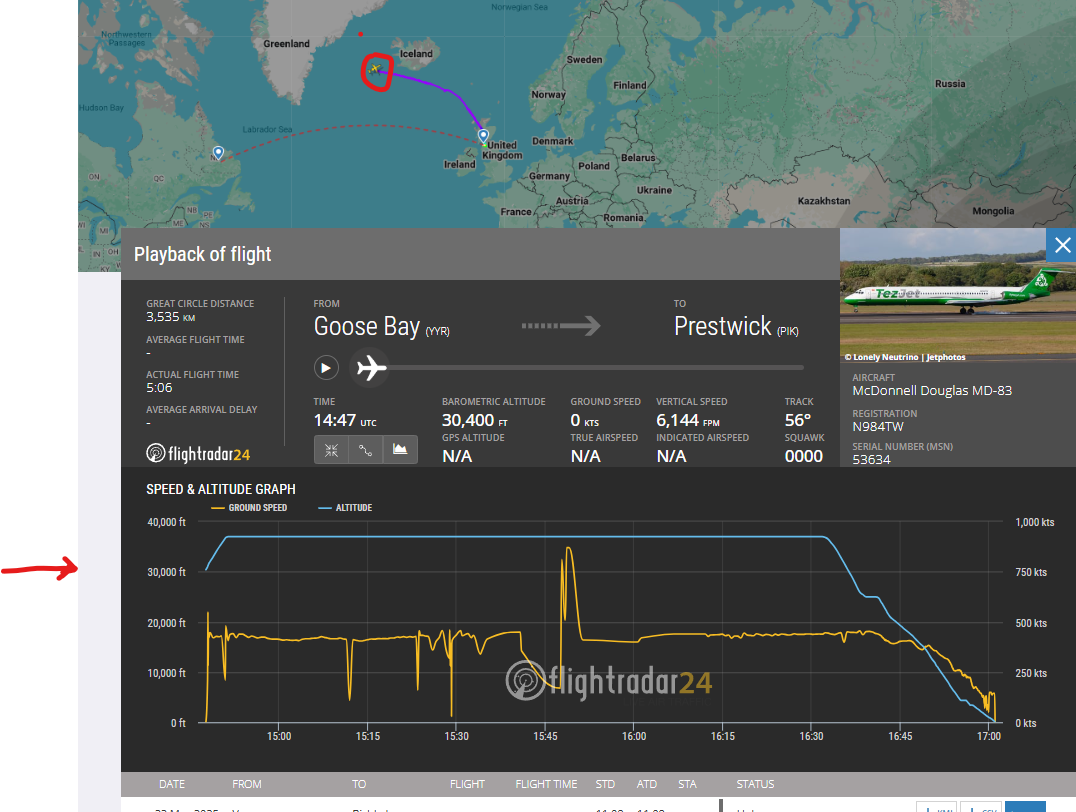
Based on the data of flightaware we see the aircraft leveled of at Flightlevel 270 after departure from Goose Bay. Flightradar does not have coverage of the flight near Goose Bay. Flightradar picks up the aircraft when it is southwest of Iceland. The aircraft is then climbing from FL300 to FL370. This is a strong idication the aircraft flew at cruis altitude FL270 from Goose Bay to roughly inbetween Greenland and Iceland.
Crew
It is not known who the crew was who ferried this aircraft. The LiveATC radio recording shows that the pilot communicating with Varna tower did not have an American accent. It looks like his native language was Spanish.
Conclusion
Very likely the part of the flight in NAT HLA airspace at FL370 controlled by Iceland and Scotland ATC was illegal as the aircraft is not certified for RVSM and it is not equipped with ADS-B Out (DO-260B).