Secretive Citation Longitude Tracked Near Attacked Galápagos Fishing Boats
A recent investigation by The Washington Post has revealed new details about one of the world’s most mysterious surveillance aircraft: a specially modified Cessna Citation Longitude operating under the designation FENIX 701.
The aircraft appears to have played a surveillance role in a series of still-unexplained incidents involving Ecuadorian fishing boats near the Galápagos Islands. According to The Washington Post, the attacks were carried out as part of a covert CIA programme, although many details about the operation and the exact role of the aircraft remain unclear.
FENIX 701 is a maritime patrol aircraft, or MPA, based on the Cessna Model 700 Citation Longitude business jet. Unlike a standard Longitude, the aircraft has been fitted with a range of specialised surveillance systems.
Photographs show an electro-optical and infrared sensor turret mounted beneath the rear fuselage. It also has a large belly radome designed to house maritime-surveillance radar and a fairing on top of the tail that is believed to contain beyond-line-of-sight communications equipment. Such systems allow an aircraft to detect and track vessels across large areas and transmit information over long distances.
One of only four known aircraft
Only four Citation Longitude aircraft with this distinctive maritime-surveillance configuration have so far been publicly identified. They have operated as N828CL, N263TH, N349CL and FENIX 701.
Very little is known about their missions. Three of the four aircraft have been associated with the same operator, Jamestown Companies.
N349CL has attracted particular attention because of its activities in the Pacific. The aircraft appeared in Fiji in 2023, where local officials said that the US government had made it available to transport regional leaders. Its exact operator and the wider purpose of its Pacific activities have never been officially clarified.
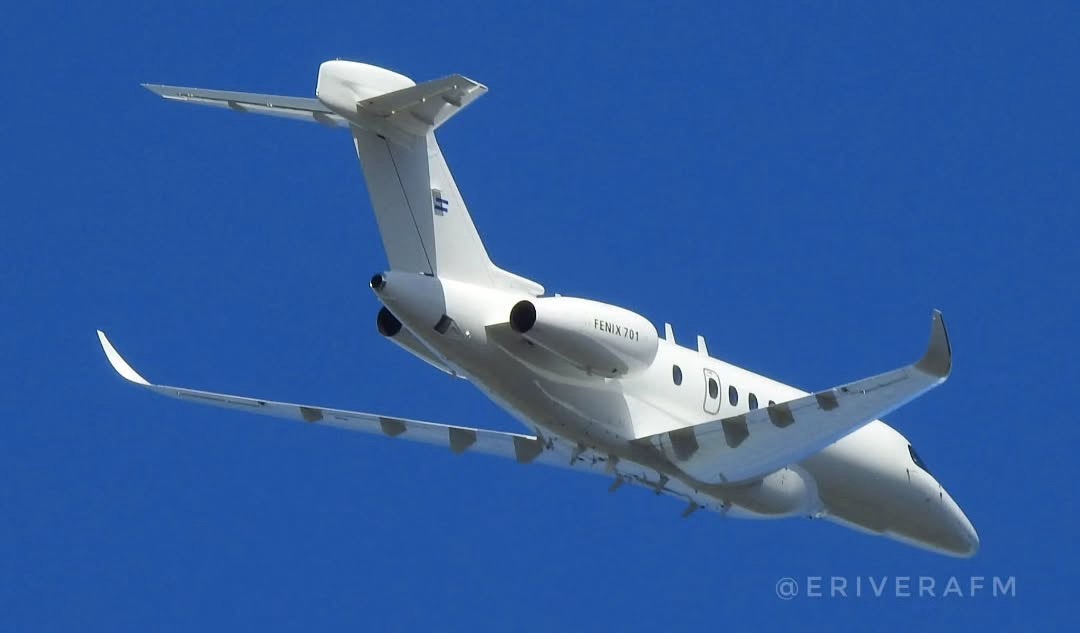
The fourth aircraft, FENIX 701, has now emerged in connection with The Washington Post’s investigation into the attacks and disappearance of fishing boats near the Galápagos Islands.
An apparent Salvadoran identity
On the surface, FENIX 701 appears to be part of the Salvadoran Air Force. The aircraft has been photographed with the flag of El Salvador on its tail, while its designation follows a numbering system also used by other Salvadoran military aircraft.
FENIX 700, for example, is a Cessna 208B Grand Caravan EX operated by the Fuerza Aérea Salvadoreña. FENIX 701 was based for several months in the military area of Ilopango International Airport, near San Salvador.
However, there are indications that its operational links may extend well beyond the Salvadoran military.
Air-traffic-control recordings reviewed by The Washington Post captured FENIX 701’s pilots speaking English with American accents. On January 20, the day the fishing vessel Fiorella disappeared, a pilot identified the aircraft to the Ilopango tower as “FENIX 701” before departing shortly before dawn.
This does not establish who operated the aircraft. It does, however, raise the possibility that it was flown by American personnel or by employees of a US government contractor rather than exclusively by members of the Salvadoran Air Force.
Neither the CIA nor the Salvadoran government has publicly explained who owns, operates or assigns missions to FENIX 701.
The N883EE connection
The aircraft probably arrived in El Salvador in November 2025. Flight-tracking records indicate that a Citation Longitude using the US registration N883EE departed Cleveland, Tennessee, on November 15. It flew via Victoria, Texas, before continuing to El Salvador.
The N-number had been reserved with the US Federal Aviation Administration by River City Companies LLC on October 24, less than a month before the delivery flight.
According to research published by Seth Hettena in The After-Action Report, River City Companies has no obvious website and lists its principal office as a mailbox at a UPS Store in Henrico, Virginia, near Richmond.
Its public records disclose little about who controls the company or what activities it conducts. River City Companies was formed in Virginia in 2021 through a commercial registered-agent service. Virginia corporate filings do not require an LLC to publicly identify its members or managers.
The opaque structure resembles arrangements previously used to register aircraft operated by private contractors working for US defence or intelligence agencies. Nevertheless, no publicly available document conclusively establishes that River City Companies is controlled by the CIA or another US government agency.
Within weeks of the aircraft’s arrival, the Latin American defence publication Pucará Defensa reported that the Salvadoran Air Force was incorporating the Longitude under the designation FENIX 701. It remains unclear whether the aircraft was transferred to El Salvador, remained the property of River City Companies or was placed at the country’s disposal through some other arrangement.
The Washington Post reported that the US registration used during the delivery flight was not attached to an active aircraft registration in publicly available FAA records. Subsequent flights also produced incomplete or unresolvable transponder data. On public tracking platforms, the aircraft sometimes appeared without a recognisable registration or aircraft type, making its movements considerably harder to follow.
Flights towards the Galápagos
The purpose of FENIX 701 has never been officially disclosed, but its equipment and recorded flight patterns strongly suggest that it has been used to locate, identify and monitor vessels at sea.
The aircraft has now been associated with three serious incidents: the disappearance of the Ecuadorian fishing vessel Fiorella and eight crew members in January 2026, and drone attacks on the fishing vessels La Negra Francisca Duarte II and Don Maca in March.
Flight-tracking data reviewed by The Washington Post showed FENIX 701 flying towards the Fiorella’s position on January 17, 18 and 20. On January 20, it travelled approximately 750 miles towards the vessel before disappearing from publicly available tracking coverage over the Pacific.
The aircraft reappeared roughly an hour before landing at Ilopango at 9.30 a.m. Around two and a half hours later, the Fiorella transmitted its position for the final time.
Two crew members who had left the Fiorella in a small skiff survived. They said they had seen a column of smoke near the vessel’s last known position. The Fiorella itself and eight other crew members have never been found.
FENIX 701 also flew towards the area in which the Don Maca was operating on the day it was attacked. Its public tracking signal again disappeared as it headed out over the Pacific.
The available flight data does not prove that FENIX 701 directed or participated in the attacks. It does, however, place a highly specialised maritime-surveillance aircraft in the direction of the vessels at critical moments.
Fishermen attacked by drones
Survivors from the Don Maca and La Negra Francisca Duarte II told investigators that small quadcopter drones attacked their vessels in March. The drones reportedly dropped explosives or detonated by crashing into the boats.
After the attacks, the fishermen said they were taken aboard a nearby blue-and-white vessel. Armed men wearing military-style uniforms allegedly handcuffed and hooded them. According to the survivors, most of the men spoke English and some wore US flag insignia.
The fishermen were subsequently transferred to the Salvadoran Navy and taken to El Salvador before eventually being returned to Ecuador.
In a July 2026 report, Human Rights Watch documented the disappearance of the Fiorella and the attacks on the other two vessels. The organisation said it could not determine who carried out the drone strikes. It called on the governments of the United States and Ecuador to disclose what they knew about the incidents and their broader security cooperation.
The US Department of Defense and US Coast Guard denied involvement or knowledge of the incidents. Ecuadorian authorities have not publicly provided a full explanation. El Salvador described its role in transporting survivors as a humanitarian operation.
A sudden departure for Texas
On April 9, as survivors of the two March attacks began speaking publicly about what had happened, flight-tracking data showed FENIX 701 departing Ilopango.
This time, the aircraft did not head west over the Pacific. Instead, it flew north and landed in San Antonio, Texas, shortly after 4 p.m.
Its present location and operational status are unclear.
The movements of FENIX 701 do not by themselves establish responsibility for the attacks. But the aircraft’s unusual ownership history, sophisticated maritime-surveillance equipment, American-sounding crews and repeated flights towards the affected vessels make it an important element in the still-unresolved case.
What remains unknown is arguably more significant than what has so far been uncovered: who ordered the aircraft’s missions, who was on board, what information it collected and whether that information was used to select or attack the fishing boats.
Until the governments involved provide answers, FENIX 701 will remain both a sophisticated surveillance platform and a visible trace of an operation designed to remain hidden